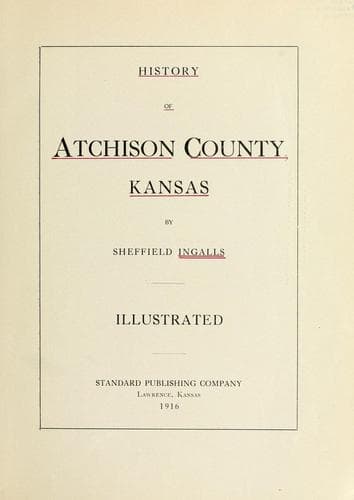
History of Atchison County, KansasIngalls, Sheffield
History
History of Atchison County, Kansas
Ingalls, Sheffield
Atchison County (Kan.) -- Biography; Atchison County (Kan.) -- History
On the fourth of December, 1914, an anniversary banquet was held in the
gymnasium, celebrating the first year of the association in its new
building, and the reports of the work accomplished at that time
dispelled any feeling there may have been on the part of some that such
an institution could not be successfully maintained in Atchison. This
banquet was attended by 200 enthusiastic friends and members of the
association, and Governor Arthur Capper was a guest of honor.
Membership in the Young Men’s Christian Association is open to any boy
or man of good character who is over ten years of age. Membership in the
Atchison association is accepted and honored in all other Young Men’s
Christian associations throughout the country. The dominant purpose of
the association is the building up of Christian character.
STATE ORPHANS’ HOME.
The legislature of the State of Kansas at the session of 1885 enacted
the first law for the establishing of a Soldiers’ Orphans’ Home at
Atchison, Kan. For the purpose of erecting the first building the
legislature appropriated the sum of $24,300 on condition that the land
should be donated to the State.
The act of the legislature provided that said Soldiers’ Orphans’ Home
“shall be an institution for the nurture, education and maintenance,
without charge, for all indigent children of soldiers who served in the
army and navy of the Union during the late rebellion, and who have been
disabled from wounds or disease, or who have since died in indigent
circumstances, and other indigent orphan children of the State.” The
institution was located at Atchison, Kan., on the present site which was
purchased from the late J. P. Brown and donated to the State. In
pursuance of the act of the legislature a portion of what is now the
main building was erected and by a subsequent appropriation was
finished, and the first children were admitted on July 1, 1887.
The original building was a four-story brick building with a basement.
The fourth story was made into a dormitory, with five rooms for
employes. The third story consisted of a smaller dormitory, lavatories,
rooms for employes and sleeping room for the superintendent. The second
story had school rooms, superintendent’s office, parlor, lavatories and
rooms for employes. The first floor rooms were dining room, kitchen,
store room, school rooms. The basement was used for boilers, store
rooms, laundry and boys’ lavatory.
The laws regulating the home were amended and enlarged by the
legislature at its session of 1889, so that all children sound in mind
and body and over two years of age and under fourteen years, belonging
to any one of the following named classes shall be eligible for
admission to the home: “First, any child dependent upon the public for
support; any dependent, neglected and ill-treated child who is an object
of public concern, and whom the State may have power to exercise and
extend its protection and control.”
Public-domain text, read in full here on John Shaqi.
Reviews
Reviews
No reviews yet
Be the first to share your thoughts on this work.
Elsewhere in the archive
Join the Discussion
Join the discussion
Sign in to leave a comment or review.
Sign InorCreate an account