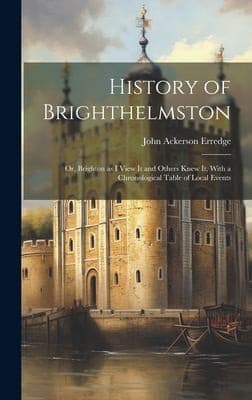
History of Brighthelmston; or, Brighton as I View it and Others Knew It: With a Chronological Table of Local EventsErredge, John Ackerson
History
History of Brighthelmston; or, Brighton as I View it and Others Knew It: With a Chronological Table of Local Events
Erredge, John Ackerson
Brighton (England) -- History
Many persons have a natural predilection for wandering amongst the tombs.
Whether in a town or village, their first impulse on arriving at a
strange place, is to visit its common burial place, to ruminate amongst
the tombs. A vastness, a solemnity, and a hallowedness seem to prevade
the spot; and the mind in quietude has an indulgence there, a moralizing
never exceeded even within the precincts of a sacred edifice.
The Poet has said,
The grave can teach
In silence, louder than divines can preach.
A celebrated moralist thus expresses himself on Epitaphs:—
When I look upon the tombs of the great, every emotion of envy dies
in me; when I read the epitaphs of the beautiful, every inordinate
desire goes out; when I meet with the grief of parents upon a
tombstone, my heart melts with compassion; when I see the tombs of
parents themselves, I see the vanity of grieving for those whom they
must quickly follow; when I see kings lying by those that deposed
them—when I see rival wits placed side by side, or the holy men that
divided the world with their contests and disputes, I reflect with
sorrow and astonishment on the little competitions, factions, and
debates of mankind; when I read the several dates of the tombs of
some that died yesterday, and some six hundred years ago, I consider
that Great Day, when we shall all of us be contemporaries, and make
our appearance together.
In Brighton old churchyard there is vast material for thought, as great a
diversity “In Memoriam” existing as in any burial place in the kingdom;
the space being extensive and the monumental inscriptions numerous. Time
has obliterated many epitaphs, and destroyed numerous tombstones, few
records of the departed being discernible of dates previous to the 18th
century. Thirty years since there were several wooden erections to
record the memory of the dead; the memorial example of a catachresis,
which
Words abused implies;
As, over his head a wooden tombstone lies.
According to the minutes of a Vestry Meeting held March 16th, 1791, it
was: “Ordered that the Clerk of the Vestry do make enquiry whether the
minister of the parish has a right to demand a fee for breaking the
ground on the burial of a parishioner.” This order was made in
consequence of a dispute upon the point, between the inhabitants and the
Vicar, the Rev. Thomas Hudson.
The oldest tablet in Brighton churchyard is that at the north of the
church, placed—it being a flat stone,—to the memory of Alice, the wife of
Richard Masters, who died May, 25th, 1696. It is contiguous to
headstones that bear the most quaint epitaphs in the whole ground.
Immediately near it is that of Mary Sanders, April, 1753, and bears this
injunction to her surviving family:—
My loving children, all agree;
Pray live in Love and Unity.
The tomb next to it is thus inscribed:—
Public-domain text, read in full here on John Shaqi.
Reviews
Reviews
No reviews yet
Be the first to share your thoughts on this work.
Elsewhere in the archive
Join the Discussion
Join the discussion
Sign in to leave a comment or review.
Sign InorCreate an account