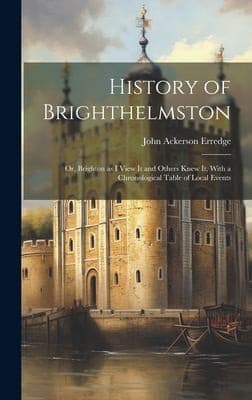
History of Brighthelmston; or, Brighton as I View it and Others Knew It: With a Chronological Table of Local EventsErredge, John Ackerson
History
History of Brighthelmston; or, Brighton as I View it and Others Knew It: With a Chronological Table of Local Events
Erredge, John Ackerson
Brighton (England) -- History
betrothed to join in the mazy dance; when—whilst all was merriment
and joy,—suddenly a wintry dismal blast passed through the hall. The
lights were quickly extinguished, the din and clamour of war seemed
to assail the castle walls on every side; and whilst the guests stood
in darkness and in stupid wonder, in a moment vivid flashes of
lightning shot across the richly tapestried walls, and displayed the
fight renewed on Mount Caburn’s side. The hill and dale were seen
distinctly, as if broad day were shining, and the combatants eagerly
engaged. But when Lord Pevensey again lifted his battle-axe to
strike Earl de Warrene, all disappeared and total darkness ensued;
the clamour ceased against the castle walls; lights were brought, but
the guests, terrified, gloomily withdrew. On the morrow, Earl de
Warrene hither to Brighthelmston, to St. Bartholomew’s Chapel came,
and by the counsel of the holy fathers, built a ship, gaily trimmed,
and named ‘St. Nicholas’ Galley,’ to bear his son to the blessed
Virgin’s tomb. It was fixed that when he should return from
performing his noble mother’s vow, then should he wed the fair Edona.
The vessel gallantly dashed from Mecheem {109} harbour, and bounded
over the yielding wave, making his way for brighter—not happier
climes. Lord Manfred safely arrived at Byzantium, and performed his
sacred duty. It was noon on the 17th of happy May—another year had
rolled its wain—when a sail, bearing the well known pennant of St.
Nicholas, was descried off Wordinges (Worthing) point by one of the
Fathers of this Chantry. Instantly a messenger was sent to carry the
welcome tidings to Earl de Warrene, who, with all his retinue, a
train of gallant bearing, his noble lady, the Lord of Bramber with
the Lady Edona, and the holy Abbot of the priory, with all his
brotherhood, had, in a few hours, assembled beneath the Earl’s
banner, on the hill where now stands St. Nicholas’ Church. The day
was fair, the wind was favourable, and the ‘St. Nicholas’ glided
swiftly on her way; the holy fathers sang with cheerful voices. The
Earl watched, with beaming eyes, for the signal agreed upon. It was
made; shouts rent the air; every face shone with joy, every heart
beat with gratitude; when, in a moment, the progress of the vessel
was checked; she reeled on her side, and sank before their eyes. She
had ran full on the hidden rock off Shore-ham {110a} harbour. The
Earl and every soul around him stood motionless; not a word broke the
silence of that sad scene. To move was useless. One sad, last,
long-drawn sigh burst from Edona, and she fell never more to rise.
The Earl passed his hands over his eyes; dropped his head on his
bosom; no smile ever rested on that face again. One foreign sailor
alone of the hapless crew survived to describe (feebly indeed) the
Public-domain text, read in full here on John Shaqi.
Reviews
Reviews
No reviews yet
Be the first to share your thoughts on this work.
Elsewhere in the archive
Join the Discussion
Join the discussion
Sign in to leave a comment or review.
Sign InorCreate an account