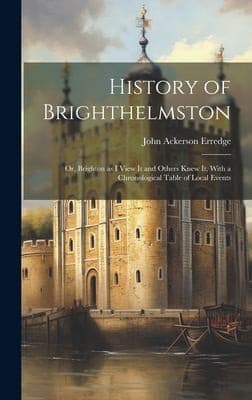
History of Brighthelmston; or, Brighton as I View it and Others Knew It: With a Chronological Table of Local EventsErredge, John Ackerson
History
History of Brighthelmston; or, Brighton as I View it and Others Knew It: With a Chronological Table of Local Events
Erredge, John Ackerson
Brighton (England) -- History
From their exposed position, the inscriptions on many of the tombstones
have been erased by the hand of time; nor can one be found of the many
recorded in a Diary, kept in 1778 and 1779, of the character alluded
to.—“Monday, September 7th, 1778. My landlord is persuading his eldest
son, and of course heir apparent, a young prince Crispin, to go to sea.
I desire the father to visit the churchyard, and upon various monuments
of youth he may observe the following inscription:—
Parents and Friends, weep not for me,
Tho’ I was drownded in the sea!—
and then, after due deliberation, if he chose to renew his persuasions he
must use his pleasure. The poor man seemed overwhelmed in thought, and
much struck. Perhaps the lad may suffer no further solicitation on this
account, unless his father should turn out to be a staunch
predestinarian.”
To the north of the church is a dwarf head-stone, thus inscribed:—
Sacred to the memory of EDMUND BORMAN, who was accidently killed,
February 11th, 1796—aged 49 years.
His death was caused thus:—He was superintending the erection of a new
flag-staff, for the vane, mentioned in page 84, for Mr. Stephen Poune,
the Churchwarden; and having gone aloft, within the tower, to make
everything safe in lowering the remains of the old flag-staff, he
hastened down, to receive it below, when, just as he emerged from the
belfry door, the mass, which was being lowered, having descended much
quicker than he expected, came down upon him, crushing him fearfully, so
that he died within an hour of the accident. Deceased was bowler to the
Prince of Wales and the Duke of York, leader of the ringers and conductor
of the choir at the Church, and, being a person of good education, a
generally useful man.
On the west portion of the ground, the record of the death of Miss
Coupland, who was killed by the fall of a wall, in Church Street, where
the Royal Stables now are, whilst walking to the Parish Church, to act as
bridesmaid at the wedding of a young friend, cannot fail to be read with
interest. The shoes which she wore on the occasion are still preserved
by a member of her family named Hibben, who worked for her father, the
owner of the premises and smithy, which for so many years formed the
obstruction to the Royal Entrance at the bottom of Church Street. The
epitaph runs:
Sacred to the memory of MARY COUPLAND, died 9th November, 1800—aged
19.
Public-domain text, read in full here on John Shaqi.
Reviews
Reviews
No reviews yet
Be the first to share your thoughts on this work.
Elsewhere in the archive
Join the Discussion
Join the discussion
Sign in to leave a comment or review.
Sign InorCreate an account