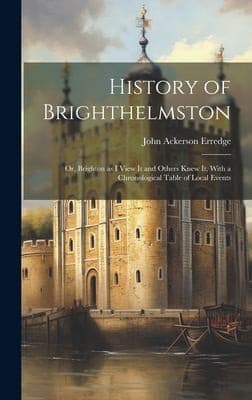
History of Brighthelmston; or, Brighton as I View it and Others Knew It: With a Chronological Table of Local EventsErredge, John Ackerson
History
History of Brighthelmston; or, Brighton as I View it and Others Knew It: With a Chronological Table of Local Events
Erredge, John Ackerson
Brighton (England) -- History
At the time when grave-yard robbers, termed Resurrectionists, were the
dread of surviving relatives, in 1820–21, these desecrators of the silent
tomb paid the Old Churchyard a visit, in the autumn of the former year,
and conveyed away at least one body, the chief of the sacrilegious
wretches being Williams, who, in 1831, was executed at Newgate, with
Bishop, for “Burking” an Italian boy. The circumstance of the body being
stolen greatly alarmed the inhabitants, and for many years afterwards it
was the constant practice to have watchers, under a species of impromptu
tent, night after night, for months together, upon the death of a person,
to prevent the body from being conveyed away. At one period the system
of watching had become such a nuisance that persons were afraid to
venture through the burial ground after dusk—the time when the watchers
went on duty—as the parties were not satisfied with being there to scare
off the expected marauders, but they took with them creature comforts in
the form of beer, spirits, and tobacco, and armed themselves with
pistols, guns, and swords, so that, when the alcoholic spirits began to
rise, there was a great lack of discretion, and frequent broils in
consequence ensued. The churchwardens, therefore, interfered and
prevented their having any other arms than stout sticks. This reckless
and indecent profanation of the sacred dormitory lamentably recalls to
one’s mind the vitiated taste and customs of the early ages, when
churchyards were no sooner enclosed than they were appropriated as places
of public amusement. According to Aubrey, “in every parish was a
church-house, to which belonged spits, crocks, and other utensils, for
dressing provisions. Here the housekeepers met, the young people were
there, too, and had dancing, bowling, shooting at butts, &c., the
ancients gravely sitting by and looking on.” Fosbrook further informs
us, that “Whitsun ales were brewed by the churchwardens, and sold in the
church; and the profits—there being no rates for the relief of the
poor—were distributed amongst them.” It was, also, customary for barbers
to come and shave the parishioners in the churchyard on Sundays and high
festivals, before matins. This liberty continued till 1422, when it was
restrained by a particular prohibition of Richard Flemyng, Bishop of
Lincoln.
Public-domain text, read in full here on John Shaqi.
Reviews
Reviews
No reviews yet
Be the first to share your thoughts on this work.
Elsewhere in the archive
Join the Discussion
Join the discussion
Sign in to leave a comment or review.
Sign InorCreate an account