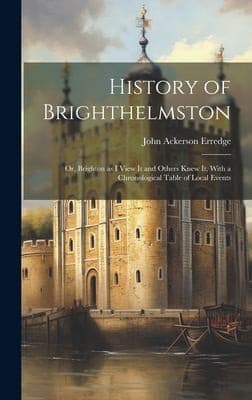
History of Brighthelmston; or, Brighton as I View it and Others Knew It: With a Chronological Table of Local EventsErredge, John Ackerson
History
History of Brighthelmston; or, Brighton as I View it and Others Knew It: With a Chronological Table of Local Events
Erredge, John Ackerson
Brighton (England) -- History
their preservation was so much concerned. His Matie. promised noebody
should know. I abided there keeping the horses in readiness in case
anything unexpected had happened. At 8 o’clock I saw them on sayle, and
it was the afternoon before they were out of sight. The wind (O
Providence) held very good till the next morning, to ten of the clock
brought them to a place of Normandie called Fackham, some three miles
from Havre de Grace, 15 Oct. Wenseday. They were no sooner landed but
the wind turned, and a violent storme did arise, in soe much that the
boateman was forced to cut his cable, lost his anchor to save his boate,
for which he required of me £8, and had it. The boate was back againe at
Chichester, by Friday, to take his fraught. I was not gone out of the
town of Brighthelmston twoe houres, but soldiers came thither to search
for a tall man 6 foot and 4 inches high.”
By the foregoing it will be seen that Charles never visited, much less
slept at Ovingdean Grange, as has been stated by some historical writers,
playwrights, and writers of romance. {130}
The vessel in which Charles escaped, was the “Surprise,” the property of
Captain Nicholas Tettersell, whose virtues are engraved upon his tomb in
the Old Church-yard,—_vide_ Chapter XVI. The vessel was a brig which had
been detained a few years previously, in the Downs, by a royal squadron,
on her way from Newcastle, with a cargo of coals, but was released by a
personal order of Charles, then Prince of Wales, whose features were
consequently known to Tettersell, notwithstanding the king’s attempt to
disguise himself. The brig at the time of the engagement with
Tettersell, was half laden with coals, and the sailors were in a great
measure disengaged from duty. In order, therefore, to collect them
without exciting suspicion, he announced that she had broken from her
moorings. By this means, having got his crew on board, he signified to
them his engagement in a secret expedition, in which their service should
not go unrewarded. Matters being thus prudently adjusted, Tettersell
went ashore by himself, in order to get a bottle of spirits, and to
inform his wife that he should be absent for a few days. Curiosity
urging the good woman to dive into the mystery of so sudden and
unreasonable a departure, he was at last constrained by her importunity
to reveal to her the nature of the service he had undertaken; and she,
with a fortitude and fidelity which reflect a lustre on her memory,
earnestly exhorted him to an honourable performance of his engagement
with the illustrious fugitive. It is recorded by Baker, in his
Chronicles, that in the course of the day, as the king, who still
retained his disguise, that of a Puritan, was sitting on the deck, one of
the sailors stood close to windward of him smoking his pipe, and on being
rebuked by the captain for making so free, retired, muttering, “truly a
cat may look at a king,” but without being aware how personally apposite
the adage was.
Public-domain text, read in full here on John Shaqi.
Reviews
Reviews
No reviews yet
Be the first to share your thoughts on this work.
Elsewhere in the archive
Join the Discussion
Join the discussion
Sign in to leave a comment or review.
Sign InorCreate an account