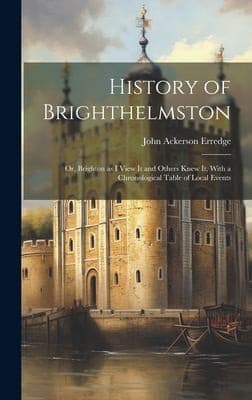
History of Brighthelmston; or, Brighton as I View it and Others Knew It: With a Chronological Table of Local EventsErredge, John Ackerson
History
History of Brighthelmston; or, Brighton as I View it and Others Knew It: With a Chronological Table of Local Events
Erredge, John Ackerson
Brighton (England) -- History
The house being erected in so exposed and elevated a situation, one of
the highest of the South-Down range, damage by gales and storms is very
frequent. From the loneliness of its position, too, burglars have made
various attempts to obtain spoil, but the reception they have always met
with has rendered their expeditions a trouble rather than a profit. The
spot was especially chosen by the late Duke of St. Albans for his hawking
excursions, as it afforded an extensive range of sight to the numerous
company of nobility and gentry, who attended upon such occasions to
witness that old English pastime. The Brighton Harriers, at least once a
week during the season, throw off here, and other packs make it their
place of meeting.
But to return to the more immediate subject of this Chapter, the
feathered tribe, from which there has been a slight digression, for the
record of facts that form an important link in the chain of local
history:
The Buzzard—_Falco buteo_,—is another of our indigenous birds, which has
nearly disappeared from this district, and what was many years ago called
the Common Buzzard is now very rare. They were formerly frequently met
with among the furze near the edge of the cliffs, where they were
constantly at war with the Jackdaws.
The Black Redstart—_Sylvia tithys_,—is considered rare in this country;
but Brighton has been fortunate in affording several examples of this
handsome and graceful bird, which is a winter visitor.
The Common Redstart—_Sylvia phœnicurus_,—unlike his _confrere_, is a
summer visitor, generally arriving about the second week in April. Their
migration seems to be gregarious, as they are to be met with in flocks of
ten or a dozen, close by the sea shore, a little to the westward of
Brighton, where they have apparently just arrived. In a day or two, they
distribute themselves over the country, and are hardly ever seen again,
but singly, or at most in pairs. This bird has several dark red feathers
on the rump, and the country people call it the Fire Tail.
The Grasshopper Warbler—_Sylvia locustella_,—is a very shy bird, and
consequently is very rarely seen. It is a great ventriloquist, and its
note is exactly like the grasshopper, (hence its name), only very much
louder, and so very peculiar, that a person may be within a yard or two
of the bird, and yet be unable to define the exact spot. It is not a
scarce bird, and several nests of it have been found at the Holm-bush,
and almost any fine evening in June it may be heard there. Its haunts
are at the edges of large woods, in low scrubby bushes.
The Sedge Warbler—_Sylvia phragmitis_,—may be found in the Summer months
in the marshes that run up from Shoreham to Beeding. It is one of our
night singing birds.
Public-domain text, read in full here on John Shaqi.
Reviews
Reviews
No reviews yet
Be the first to share your thoughts on this work.
Elsewhere in the archive
Join the Discussion
Join the discussion
Sign in to leave a comment or review.
Sign InorCreate an account