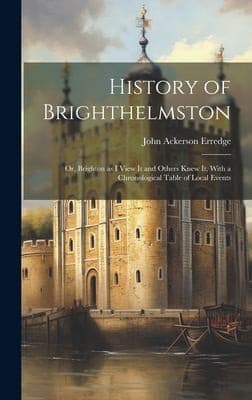
History of Brighthelmston; or, Brighton as I View it and Others Knew It: With a Chronological Table of Local EventsErredge, John Ackerson
History
History of Brighthelmston; or, Brighton as I View it and Others Knew It: With a Chronological Table of Local Events
Erredge, John Ackerson
Brighton (England) -- History
Thirteen regiments were present at the execution, which for nearly fifty
years was pointed out by the form of the coffins, the positions of the
men firing, and other incidents of the scene, being cut out in the turf
by the shepherd, whose innocent flocks browsed where so tragic an affair
occurred. The plough has since obliterated all traces of the tragedy
from the spot.
A singular instance of the effect of nervous excitement is connected with
the execution. The Rev. Mr. Dring, the Chaplain of the regiment, who
attended the culprits in their last moments, being a nervous man, and
having a great horror of the duty which he had to perform, made a special
request that after he had administered to them the last religious
consolation, he should have sufficient time to get beyond the sound of
the report of the fatal muskets before the order to fire was given.
Promise of compliance with his request was made; but either from his
tardy progress in leaving the spot, or a miscalculation of time, the word
of command was given, and the firing took place while he yet was within
hearing. The effect upon him was that he fell to the ground, and never
after recovered the shock upon his nerves.
The bodies of the two mutineers were interred in Hove churchyard,
contiguous to the centre of the old north boundary wall, where their
remains continued undisturbed till the restoration of the Church, in
1834, when a saw-pit was dug at the actual spot, and a few of their bones
were exhumed. The burying party was under Sergeant-Major Masters, who
afterwards was a publican at Witney. The receipt for the burial fees on
the interment of the bodies is still retained by his family. A few years
since, Mr. Samuel Thorncroft, the Assistant-Overseer of Brighton, being
at Witney, by chance called at Masters’s house, when, the subject of the
execution of the two men being introduced, the receipt referred to was
shown him, and Masters stated that so infamously constructed were the
coffins in which the corpses were put that, notwithstanding they were
buried in their regimental attire, their blood oozed through the coffins
and ran down the backs of their comrades who conveyed them to their
grave.
The vicinity of Goldstone Bottom is memorable not only for these military
executions, but, also, for the hanging and gibbeting of two men, James
Rook and Edward Howell, on the 26th of April, 1793, just north of the Old
Shoreham road, beyond Hove Drove. Their crime was robbing the mail, at
that time conveyed between Brighton and Shoreham by a lad, named John
Stephenson, on horseback. The robbery took place on the night of the
30th of October, 1792. What they took was of little value; and they used
no violence. In a barn adjacent they broke open the letters and shared
their trifling contents.
Public-domain text, read in full here on John Shaqi.
Reviews
Reviews
No reviews yet
Be the first to share your thoughts on this work.
Elsewhere in the archive
Join the Discussion
Join the discussion
Sign in to leave a comment or review.
Sign InorCreate an account