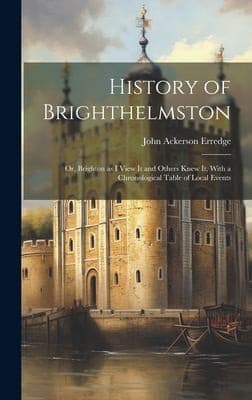
History of Brighthelmston; or, Brighton as I View it and Others Knew It: With a Chronological Table of Local EventsErredge, John Ackerson
History
History of Brighthelmston; or, Brighton as I View it and Others Knew It: With a Chronological Table of Local Events
Erredge, John Ackerson
Brighton (England) -- History
The Brief, from the trial not having been proceeded with, is not endorsed
to any Counsel, but is marked “Brooker, Brighton,” the original of the
firm, Messrs. Brooker and Penfold, now Messrs. Penfold and Son,
solicitors.
Phœbe Hassell, the person who was chiefly instrumental in bringing Rook
and Howell to justice, was a very celebrated character. She was born at
Stepney, London, in March, 1713, of respectable parents, named Smith. Of
her early life little is known; but the first incident of her remarkable
career, as related by herself to the compiler of this work, was her
falling in love with Samuel Golding, a private in the regiment known as
Kirke’s Lambs. Phœbe Smith then was but fifteen years of age, being, as
she used to remark, a fine lass for her years. Golding’s regiment being
ordered to the West Indies in 1728, such was Phœbe’s attachment for him,
that, donning the garb of a man, she enlisted into the 5th regiment of
Foot, commanded by General Pearce, then under orders, also for the West
Indies, and embarked after him. There she served for five years without
discovering herself to any one. She was likewise at Monserrat, and would
have been in the action there, but her regiment did not reach the island
till after the battle was over. Soon after her return to England her
regiment was ordered to join the forces under the Duke of Cumberland, on
the continent, and she was present at the battle of Fontenoy, May 1st,
1745, when she received a bayonet wound in her arm. Golding’s and her
regiment were afterwards at Gibraltar, where he got wounded, and was then
invalided home to Plymouth. Phœbe then informed the Lady of General
Pearce of her sex and story, obtained her discharge, and was immediately
sent to England. She went to the military hospital at Plymouth, with
letters of recommendation from her late Colonel, and there nursed
Golding; and when he came out of the hospital they were married, and
lived happily together for more than 20 years. Golding had a pension
from Chelsea.
After but a short widowhood, she married William Hassell, of whom little
is known beyond what is recorded in the parish book of Brighton; extracts
from which will show that in 1792 they were in poverty, as at a meeting
of the Churchwardens and Overseers, held at the Castle Tavern, on the 5th
of December that year, it was:—“Ordered that Phœbe, the wife of William
Hassell, be paid three guineas to get their bed and netts, which they had
pledged to pay Dr. Henderson for medicine.”
Hassell died about this period, and Phœbe then, by the assistance of a
few of the inhabitants, purchased a donkey, and travelled with fish and
other commodities to the villages westward; and it was on one of these
journeys that she obtained the capture of Rook and Howell for robbing the
mail.
The following minute appears in the Vestry book:—
Public-domain text, read in full here on John Shaqi.
Reviews
Reviews
No reviews yet
Be the first to share your thoughts on this work.
Elsewhere in the archive
Join the Discussion
Join the discussion
Sign in to leave a comment or review.
Sign InorCreate an account