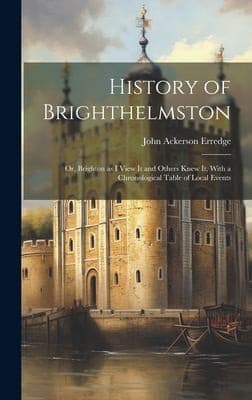
History of Brighthelmston; or, Brighton as I View it and Others Knew It: With a Chronological Table of Local EventsErredge, John Ackerson
History
History of Brighthelmston; or, Brighton as I View it and Others Knew It: With a Chronological Table of Local Events
Erredge, John Ackerson
Brighton (England) -- History
About the year 1750 the medical use of sea-water in scrofulous and other
glandular complaints, under the unwearied and successful attention of Dr.
Richard Russell, who removed hither from his seat at Malling, near Lewes,
established his fame and also that of the town all over the kingdom. He
may in truth be considered the founder of Brighton’s greatness; and it is
much to be regretted that the inhabitants while appreciating the laudable
services and good qualities of modern Royal and Noble patrons, and
perpetuating individual virtues by works of art in marble and on canvass,
have hitherto omitted to mark their gratitude to the memory of the
learned Doctor, there being amongst the treasures of the town no memento
whatever of him. His portrait, it is true, graces the Telemachus room of
the Old Ship Hotel, but it might as well be stowed away in the ex-clock
tower of the Pavilion, so rarely have the public an opportunity of seeing
it. This hint perhaps may induce the possessor of the portrait to make a
present of it to the Corporation, who have recently received several
additions by gift to their choice collection of paintings.
The erection of lodging-houses soon became a profitable speculation in
Brighton, and that late obscure fishing village began to increase in
population and celebrity. The wonderful success of the industry and
discernment of Dr. Russell appeared by several cases of cures which he
cited in his work, “A Dissertation on the use of Sea-water;” and the most
eminent members of the faculty in England bore willing testimony to the
great acuteness and utility of his professional investigations. The
benefits which the diseased have ever since received from sea-water are,
therefore, in a great measure, to be imputed to the medical labours and
sagacity of this good man, in grateful commemoration of whom the
proprietors of a new street,—the first that was erected, composed
principally of lodging-houses for the accommodation of invalid
visitors,—named it after him, Russell Street, many of the original houses
of which that still remain, though now occupied by a different class of
persons than those for whom they were designed, show the improvement that
had then taken place in house property. The Rev. Dr. Mannington, of
Jevington, in the following epigram, simply, yet elegantly estimates the
philanthropical abilities of Dr. Russell:—
Clara per omne ævum Russelli fama manebit,
Dum retinet vires unda marina suas.
Thus translated:—
Admiring ages Russell’s fame shall know,
Till ocean’s healing waters cease to flow.
Dr. Russell’s son, William—afterwards Mr. Sergeant Kempe, on assuming the
name of his maternal grandfather,—however, who appeared to have been one
of the wits of the town at that period, by the following lines, knew the
limit of his father’s skill:—
Brighthelmston was confess’d by all
T’ abound with females fair;
But more so since fam’d Russell has
Prefer’d the waters there.
Public-domain text, read in full here on John Shaqi.
Reviews
Reviews
No reviews yet
Be the first to share your thoughts on this work.
Elsewhere in the archive
Join the Discussion
Join the discussion
Sign in to leave a comment or review.
Sign InorCreate an account