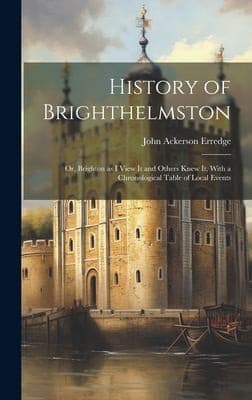
History of Brighthelmston; or, Brighton as I View it and Others Knew It: With a Chronological Table of Local EventsErredge, John Ackerson
History
History of Brighthelmston; or, Brighton as I View it and Others Knew It: With a Chronological Table of Local Events
Erredge, John Ackerson
Brighton (England) -- History
For awhile this example had a very salutary effect; but, more or less,
until the present season, the nuisance has continued. Now the New Bye
Laws prohibit bathing from the beach in front of the town, except before
the hour of six in the morning or after nine in the evening; and all
persons bathing from the machines are compelled to wear gowns, drawers,
or some such suitable covering. Less than thirty years since the bathing
from the Ladies’ Bathing Machines, between West Street and Middle Street,
was not of the most pleasant character, as it was customary for coal
brigs in fine weather, to discharge their cargoes at that spot, and
frequently, so was the surface of the water covered with fine coal dust,
that many a child who dreaded bathing, was compelled to be dipped an
extra time or two by the bathing women, to rinse off the black particles.
Some years have elapsed since the universal practice prevailed of
discharging cargoes of coal, stone, timber, &c., in front of the town,
greater facilities than formerly existed being offered now, at Shoreham,
for unloading at the wharfs, without the risk of the vessels—as was very
frequently the case,—being stranded. Great quantities of coal is also
transmitted to Brighton by rail from Deptford Creek, so that that useful
household commodity is much reduced in price to what it formerly was. In
the week prior to Christmas, 1812, such was the scarcity of coal in the
town, from adverse winds prevailing and preventing the arrival of
shipping from the north, that persons in even comfortable circumstances,
whose cellars were exhausted, purchased only to the extent of a bushel at
a time, and so indifferent were the coal merchants to part with their
coal even at £5 a chaldron—about equal to the present ton,—that at the
coal-yard of Messrs. Edmund Savage and Bonham, which was situate opposite
Ship Street Lane, in North Street, immediately above the shop of Messrs.
Palmer and Green, ironmongers, the purchaser of half-a-bushel of coal was
compelled likewise to buy at the same time sixpenny worth of uncleft
wood.
The following will show the cost of coal per chaldron at that period to
the coal merchants in the town:—
Newcastle on Tyne, the Sixteenth day of November in the year of our
Lord One Thousand Eight Hundred and Thirteen.
Public-domain text, read in full here on John Shaqi.
Reviews
Reviews
No reviews yet
Be the first to share your thoughts on this work.
Elsewhere in the archive
Join the Discussion
Join the discussion
Sign in to leave a comment or review.
Sign InorCreate an account