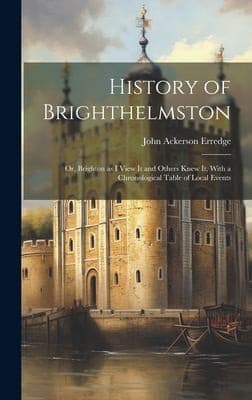
History of Brighthelmston; or, Brighton as I View it and Others Knew It: With a Chronological Table of Local EventsErredge, John Ackerson
History
History of Brighthelmston; or, Brighton as I View it and Others Knew It: With a Chronological Table of Local Events
Erredge, John Ackerson
Brighton (England) -- History
The Bill for the disposal, however, passed, and on the 27th of July,
1849, a Vestry meeting of the rated inhabitants, determined upon
purchasing the property for £53,000, the sum required for it by the
Commissioners of the Woods and Forests. Another Bill had yet to be
obtained to give the Town Commissioners power to purchase the estate.
Such an opposition to the purchase in the meantime sprung up amongst some
of the ratepayers, and at a Vestry meeting called to approve of the Bill,
that, after two days’ polling, the amendment, in effect “that the
purchase be stopped,” was only lost by a minority of 36, the numbers
being: for the purchase, 1343; against it, 1307. The Bill was read in
the House of Commons a second time, without opposition, on the 14th of
February, 1850; and was read a third time in the House of Lords on the
2nd of May, 1850. The money for the purchase, and £7,000 for the
expenses of obtaining the Bill, and to restore the building, amounting in
the whole to £60,000, was borrowed of the Bank of England, and on the
13th of June, 1850, the Commissioners of the Woods and Forests were paid
the sum required. The building is not yet wholly appropriated, but,
immediately upon the completion of the purchase, the late Mr. Christopher
Wren Vick was employed to effect the work of restoration, and he
succeeded in obtaining the original blocks from which the former
paper-hangings of the grand suite of rooms were printed, and also in
engaging Mr. Lambelet,—who has since died in poverty—the artist who
executed the original decorations. On the 21st of January, 1851, the
Pavilion was reopened with a grand ball of the inhabitants; since which
time numerous balls, concerts, and meetings of scientific, benevolent,
and other societies have taken place there, and it has now an excellent
gallery for paintings, and several rooms have been set apart for the
Brighton Museum, an institution that is well deserving of support.
Paintings, by purchase and gifts, adorn many of the walls of the
building, and in the Vestibule and Chinese Gallery are some excellent
specimens of sculpture, principally by our local sculptor, Mr. Pepper.
The most prominent is a full length statue by Noble, of the late Captain
Pechell, son of the late member for Brighton, Sir G. R. B. Pechell, Bart.
The gallant young officer fell during the Russian War, in the Crimea.
Besides the Pavilion and Grounds, the estate has many private houses,
including the magnificent range called Pavilion Buildings. The debt
consequent upon the purchase is being gradually reduced, and the
opponents to the purchase not feeling the burthen which they dreaded,
have the gratification of knowing, that, as a lung to their magnificent
town, they have that which no other town in the kingdom possesses,—an
extensive park of its own in its very centre.
CHAPTER XXVII.
ON AND ABOUT THE RACE-COURSE.
Public-domain text, read in full here on John Shaqi.
Reviews
Reviews
No reviews yet
Be the first to share your thoughts on this work.
Elsewhere in the archive
Join the Discussion
Join the discussion
Sign in to leave a comment or review.
Sign InorCreate an account