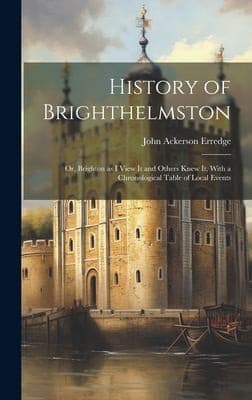
History of Brighthelmston; or, Brighton as I View it and Others Knew It: With a Chronological Table of Local EventsErredge, John Ackerson
History
History of Brighthelmston; or, Brighton as I View it and Others Knew It: With a Chronological Table of Local Events
Erredge, John Ackerson
Brighton (England) -- History
The “Flying Man” was Mr. William Constable, who, on the disposal by his
brother of his business to Mr. Ireland, accompanied Daniel to America,
where they devoted themselves to scientific pursuits. His flying freak,
on his return, was as well for a scientific purpose as to benefit Mr.
Ireland, and the principle has been since applied in saving human life in
cases of fire and shipwreck. In 1841 he introduced the art of
photography, then called Daguerreotype, into Brighton, his “blue room”
being a very attractive feature on the Marine Parade, near Atlingworth
Street. He died on Sunday, December 22nd, 1861.
Other speculators from time to time, with but little better success than
Mr. Ireland, tried their luck upon the estate. Year by year showed the
gradual decay which neglect engenders; the buildings became dilapidated
and unsafe for occupation, the flowerbeds were transformed into a
wilderness of weeds; and at length, after having been made even the
asylum for wild beasts, and the arena for the dissoluteness of pleasure
fairs, the Gardens, that might have continued one of the chief prides of
Brighton, and the Cricket Ground—the fame of which is perpetuated by
Mason’s celebrated print of the renowned players of Sussex and Kent, and
their supporters,—the envy, as it was, of other cricketing counties, were
sacrificed to the spirit of building, from the want of foresight in the
inhabitants, who now universally admit that both should have been
preserved to the town, as they were an establishment for the people’s
amusement and recreation, with which nothing of the kind in the county
could compete. The present, the Royal Brunswick Cricket Ground, kept by
the veteran Box, is capacious and well-formed; but it lacks the
picturesqueness, and the spectators have not the shelter from wind and
rain, and the shade from the trees which gave so vast a superiority to
the Hanover Ground. Previous to the formation of Ireland’s Gardens, some
tea-gardens were in existence on the Marine Parade, about the locality
now occupied by Eaton Place. They were merely a summer retreat for a cup
of tea during an afternoon stroll, and a place of call in winter for a
glass of hot elderberry wine.
In the “good old times” the people’s entertainments differed much from
the sports of the present race, as the following copy of a handbill will
show:—
COCKING.
To be fought at the Cock Pit,
WHITE LION,
NORTH STREET, BRIGHTON,
ON
THURSDAY,
THE 18TH APRIL, 1811,
A Main of Cocks for TWENTY GUINEAS
a Battle, and FIFTY GUINEAS the Main;
between the Gentlemen of the Isle of
Wight and the Gentlemen of Sussex.
Feeders: Pollard, Isle of Wight; Holden, Sussex.
Public-domain text, read in full here on John Shaqi.
Reviews
Reviews
No reviews yet
Be the first to share your thoughts on this work.
Elsewhere in the archive
Join the Discussion
Join the discussion
Sign in to leave a comment or review.
Sign InorCreate an account