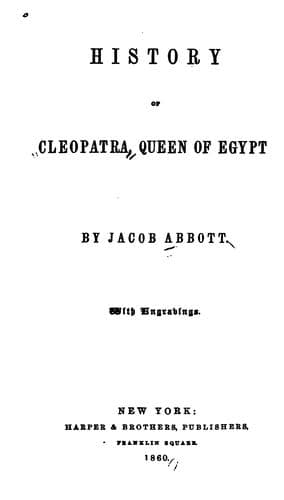
Cleopatra, Queen of Egypt, -30 B.C.; Egypt -- History -- 332-30 B.C. -- Biography; Queens -- Egypt -- Biography
In the mean time, while Antony was thus spending his time in low and
ignoble pursuits and in guilty pleasures at Alexandria, his wife Fulvia,
after exhausting all other means of inducing her husband to return to her,
became desperate, and took measures for fomenting an open war, which she
thought would compel him to return. The extraordinary energy, influence,
and talent which Fulvia possessed, enabled her to do this in an effectual
manner. She organized an army, formed a camp, placed herself at the head
of the troops, and sent such tidings to Antony of the dangers which
threatened his cause as greatly alarmed him. At the same time news came of
great disasters in Asia Minor, and of alarming insurrections among the
provinces which had been committed to his charge there. Antony saw that he
must arouse himself from the spell which had enchanted him and break away
from Cleopatra, or that he would be wholly and irretrievably ruined. He
made, accordingly, a desperate effort to get free. He bade the queen
farewell, embarked hastily in a fleet of galleys, and sailed away to Tyre,
leaving Cleopatra in her palace, vexed, disappointed, and chagrined.
CHAPTER XI.
THE BATTLE OF ACTIUM.
Cleopatra, in parting with Antony as described in the last chapter, lost
him for two or three years. During this time Antony himself was involved
in a great variety of difficulties and dangers, and passed through many
eventful scenes, which, however, can not here be described in detail. His
life, during this period, was full of vicissitude and excitement, and was
spent probably in alternations of remorse for the past and anxiety for the
future. On landing at Tyre, he was at first extremely perplexed whether to
go to Asia Minor or to Rome. His presence was imperiously demanded in both
places. The war which Fulvia had fomented was caused, in part, by the
rivalry of Octavius, and the collision of his interests with those of her
husband. Antony was very angry with her for having managed his affairs in
such a way as to bring about a war. After a time Antony and Fulvia met at
Athens. Fulvia had retreated to that city, and was very seriously sick
there, either from bodily disease, or from the influence of long-continued
anxiety, vexation, and distress. They had a stormy meeting. Neither party
was disposed to exercise any mercy toward the other. Antony left his wife
rudely and roughly, after loading her with reproaches. A short time
afterward, she sank down in sorrow to the grave.
The death of Fulvia was an event which proved to be of advantage to
Antony. It opened the way to a reconciliation between him and Octavius.
Fulvia had been extremely active in opposing Octavius's designs, and in
organizing plans for resisting him. He felt, therefore, a special
hostility against her, and, through her, against Antony. Now, however,
that she was dead, the way seemed to be in some sense opened for a
reconciliation.
Public-domain text, read in full here on John Shaqi.
Reviews
Reviews
No reviews yet
Be the first to share your thoughts on this work.
Elsewhere in the archive
Join the Discussion
Join the discussion
Sign in to leave a comment or review.
Sign InorCreate an account