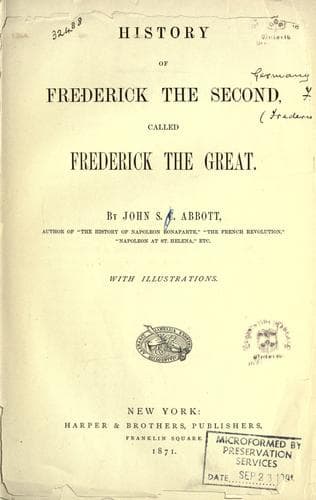
History of Frederick the Second, Called Frederick the Great.Abbott, John S. C. (John Stevens Cabot)
History
History of Frederick the Second, Called Frederick the Great.
Abbott, John S. C. (John Stevens Cabot)
Frederick II, King of Prussia, 1712-1786; Prussia (Germany) -- History -- Frederick II, 1740-1786
It will be remembered that Prince Charles was at the head of a strong
Austrian army, on the western banks of the Rhine. It numbered over
fifty thousand combatants. The King of France had pledged himself to
press them closely, so that they could not recross the Rhine and rush
into Bohemia to thwart the operations of Frederick; but, unfortunately,
Louis XV. was seized with a malignant fever, which brought him near
to the grave. Taking advantage of this, Prince Charles, on the night
of the 23d of August, crossed the Rhine with his whole army. It was
bright moonlight, so that every movement was as visible as if it had
been made by day. But the French officers, glad thus to be rid of the
Austrian army, preferring much that Frederick should encounter it in
Bohemia than that they should struggle against it on the Rhine, went
quietly to their beds, even forbidding the more zealous subalterns from
harassing Prince Charles in his passage of the river. It was then the
great object of the French to take Freyburg. The withdrawal of Prince
Charles, with his fifty thousand men, was a great relief to them.
While Frederick was involved in all these difficulties, he was cheered
by the hope that the French would soon come to his rescue. Unutterable
was his chagrin when he learned, early in October, that the French had
done exactly as he would have done in their circumstances. Appalling,
indeed, were the tidings soon brought to him, that Prince Charles, with
his army, had marched unmolested into Bohemia; that he had already
effected a junction with General Bathyani and his countless swarm of
Pandours; and, moreover, that a Saxon army, twenty thousand strong, in
alliance with the Queen of Hungary, was on the way to join his already
overwhelming foes. It was reported, at the same time, that Prince
Charles was advancing upon Budweis, and that his advance-guard had been
seen, but a few miles off, on the western side of the Moldau.
The exigency demanded the most decisive action. Frederick promptly
gathered his army, and dashed across the Moldau, resolved, with the
energies of despair, to smite down the troops of Prince Charles; but no
foe could be found. For four days he sought for them in vain. He then
learned that the Austrian army had crossed the Moldau several miles
north of him, thus cutting off his communications with Prague.
Though Prince Charles was nominally commander-in-chief of the Austrian
forces, Marshal Traun, as we have mentioned, was its military head.
He was, at that time, far Frederick’s superior in the art of war.
Frederick had sufficient intelligence and candor to recognize that
superiority. When he heard of this adroit movement of his foes, he
exclaimed, “Old Traun understands his trade.”
Public-domain text, read in full here on John Shaqi.
Reviews
Reviews
No reviews yet
Be the first to share your thoughts on this work.
Elsewhere in the archive
Join the Discussion
Join the discussion
Sign in to leave a comment or review.
Sign InorCreate an account