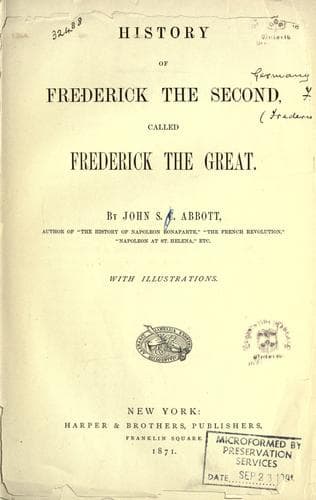
History of Frederick the Second, Called Frederick the Great.Abbott, John S. C. (John Stevens Cabot)
History
History of Frederick the Second, Called Frederick the Great.
Abbott, John S. C. (John Stevens Cabot)
Frederick II, King of Prussia, 1712-1786; Prussia (Germany) -- History -- Frederick II, 1740-1786
“We had just arrived there when it began to rain heavily, and the
night became exceedingly dark. About nine o’clock one of the Austrian
generals approached us with his light troops, and set fire to the
houses close to which we were posted. By the blaze of the conflagration
he soon discovered us, and began firing at us from the windows. The
town was so full that it was impossible for us to find a place in it.
Besides, the gate was barricaded, and from the top they were firing at
us with our small field-pieces, which they had captured.
“In the mean time the Austrians had turned in upon us a rivulet, and by
midnight we found our horses in the water up to their bellies. We were
really incapable of defending ourselves.”
Just at that time, when all hope seemed lost, it so happened that a
cannon-ball crushed the foot of the Austrian commander. This disaster,
together with the darkness and the torrents of rain, caused the fire of
the enemy to cease. The next morning some Prussian re-enforcements came
to the rescue of the king, and he escaped.
It was on the night of the 25th of November, cold and dreary, that
General Einsiedel commenced his retreat from Prague. He pushed his
wagon trains out before him, and followed with his horse and foot.
The Austrians were on the alert. Their light horsemen came clattering
into the city ere the rear-guard had left. The Catholic populace of
the city, being in sympathy with the Austrians, immediately joined the
Pandours in a fierce attack upon the Prussians. The retreating columns
were torn by a terrific fire from the windows of the houses, from
bridges, from boats, from every point whence a bullet could reach them.
But the well-drilled Prussians met the shock with the stern composure
of machines, leaving their path strewn with the dying and the dead.
The heroic General Einsiedel struggled along through the snow and over
the pathless hills, pursued and pelted every hour by the indomitable
foe. He was often compelled to abandon baggage-wagons and ambulances
containing the sick, while the wounded and the exhausted sank freezing
by the way. At one time he was so crowded by the enemy that he was
compelled to continue his march through the long hours of a wintry
night, by the light of pitch-pine torches. After this awful retreat of
twenty days, an emaciate, ragged, frostbitten band crossed the frontier
into Silesia, near Friedland. They were soon united with the other
columns of the discomfited and almost ruined army.
It will generally be admitted by military men that Frederick did not
display much ability of generalship in this campaign. He was fearless,
indomitable in energy, and tireless in the endurance of fatigue, but in
generalship he was entirely eclipsed by his formidable rival. Indeed,
Frederick could not be blind to this, and he had sufficient candor to
confess it. Subsequently, giving an account of these transactions in
his “Works,” he writes:
Public-domain text, read in full here on John Shaqi.
Reviews
Reviews
No reviews yet
Be the first to share your thoughts on this work.
Elsewhere in the archive
Join the Discussion
Join the discussion
Sign in to leave a comment or review.
Sign InorCreate an account