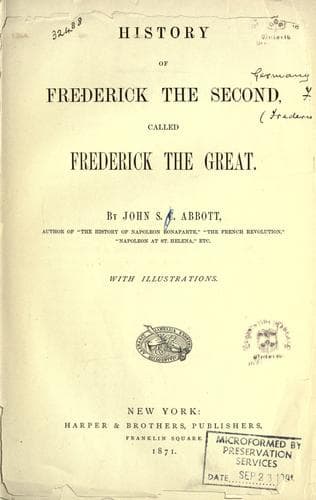
History of Frederick the Second, Called Frederick the Great.Abbott, John S. C. (John Stevens Cabot)
History
History of Frederick the Second, Called Frederick the Great.
Abbott, John S. C. (John Stevens Cabot)
Frederick II, King of Prussia, 1712-1786; Prussia (Germany) -- History -- Frederick II, 1740-1786
“War is cruelty,” said General Sherman; “and you can not refine
it.” “No man of refined Christian sensibilities,” said the Duke of
Wellington, “should undertake the profession of a soldier.” The
exigencies of war often require things to be done from which humanity
revolts. “War,” said Napoleon I., “is the science of barbarians.” One
of the principal objects of Frederick in this pursuit of the Austrians
through Bohemia was to lay waste the country so utterly, destroying
its roads and consuming its provisions, that no Austrian army could
again pass through it for the invasion of Silesia. Who can imagine the
amount of woe thus inflicted upon the innocent peasants of Bohemia?
Both armies were reduced to the necessity of living mainly upon the
resources of the country in which they were encamped. Their foraging
parties were scattered in all directions. There were frequent attacks
of outposts and bloody skirmishes, in which many were slain and many
were crippled for life. Each death, each wound, sent tears, and often
life-long woe, to some humble cottage.
There are sometimes great and glorious objects to be attained--objects
which elevate and ennoble a nation or a race--which warrant the
expenditure of almost any amount of temporary suffering. It is not
the duty of the millions to suffer the proud and haughty hundreds to
consign them to ignorance and trample them in the dust. In this wicked
world, where kings and nobles have ever been so ready to doom the
masses of the people to ignorance, servitude, and want, human rights
have almost never made any advances but through the energies of the
sword. Many illustrious generals, who, with saddened hearts, have led
their armies over fields of blood, have been among the most devoted
friends and ornaments of humanity. Their names have been enshrined in
the affections of grateful millions.
But this war, into which the Prussian king had so recklessly plunged
all Europe, was purely a war of personal ambition. Even Frederick did
not pretend that it involved any question of human rights. Unblushingly
he avowed that he drew his sword and led his hundred thousand
peasant-boys upon their dreadful career of carnage and misery simply
that he might enlarge his territories, gain renown as a conqueror, and
make the world talk about him. It must be a fearful thing to go to the
judgment seat of Christ with such a crime weighing upon the soul.
War has its jokes and merriment, but the comedies of war are often more
dreadful than the tragedies of peace. Frederick, in his works, records
the following incident, which he narrates as “slight pleasantry, to
relieve the reader’s mind:”[83]
Public-domain text, read in full here on John Shaqi.
Reviews
Reviews
No reviews yet
Be the first to share your thoughts on this work.
Elsewhere in the archive
Join the Discussion
Join the discussion
Sign in to leave a comment or review.
Sign InorCreate an account