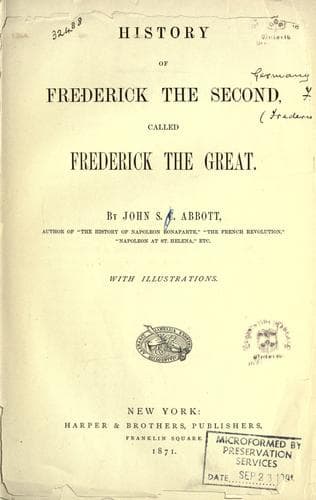
History of Frederick the Second, Called Frederick the Great.Abbott, John S. C. (John Stevens Cabot)
History
History of Frederick the Second, Called Frederick the Great.
Abbott, John S. C. (John Stevens Cabot)
Frederick II, King of Prussia, 1712-1786; Prussia (Germany) -- History -- Frederick II, 1740-1786
It is pleasant to record another incident more creditable to Frederick.
In the year 1750 there was a poor and aged schoolmaster, by the name
of Linsenbarth, a very worthy man, a veritable Dominie Sampson,
residing in the obscure village of Hemmleben. He had been educated as a
clergyman, had considerable book learning, was then out of employment,
and was in extreme destitution. The pastor of the village church died,
leaving a vacant pulpit, and a salary amounting to about one hundred
dollars a year. The great man of the place, a feudal lord named Von
Werthern, offered the situation to Linsenbarth upon condition that he
would marry his lady’s termagant waiting-maid. Linsenbarth, who had no
fancy for the haughty shrew, declined the offer. The lord and lady were
much offended, and in various ways rendered the situation of the poor
schoolmaster so uncomfortable that he gathered up his slender means,
amounting to about three hundred dollars, all in the deteriorated coin
of the province, and went to Berlin. His money was in a bag containing
nearly nine thousand very small pieces of coin, called _batzen_.
At the custom-house the poor man’s coin was seized as contraband. He
was informed that the king, had forbidden the circulation of that kind
of money in Berlin. The heartless officials laughed at the poor man’s
distress, paid no regard to his remonstrances and pleadings, and locked
up his confiscated coin.
Poor Linsenbarth had a feather bed, a small chest of clothes, and a bag
of books. He went to a humble inn, called the “White Swan,” utterly
penniless. The landlord, seeing that he could levy upon his luggage in
case of need, gave him food and a small room in the garret to sleep
in. Here he remained in a state verging upon despair for eight weeks.
Some of the simple neighbors advised him to go directly to the king, as
every poor man could do at certain hours in the day. He wrote a brief
statement of the facts, and started on foot for Potsdam. We give the
result in the words of Linsenbarth:
“At Potsdam I was lucky enough to see the king. He was on the esplanade
drilling his troops. When the drill was over he went into the garden,
and the soldiers dispersed. Four officers remained lounging on the
esplanade. For fright, I knew not what to do; I drew the papers from my
pocket. These were my memorial, two certificates of character, and a
Thuringian pass. The officers, noticing this, came directly to me and
said, ‘What letters have you there?’ I thankfully imparted the whole.
When the officers had read them, they said, ‘We will give you good
advice. The king is extra gracious to-day, and is gone alone into the
garden. Follow him straight. You will have luck.’
Public-domain text, read in full here on John Shaqi.
Reviews
Reviews
No reviews yet
Be the first to share your thoughts on this work.
Elsewhere in the archive
Join the Discussion
Join the discussion
Sign in to leave a comment or review.
Sign InorCreate an account