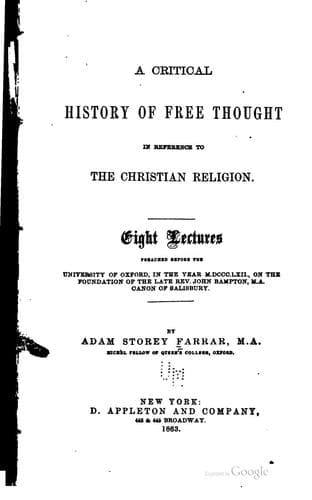
History of Free Thought in Reference to The Christian ReligionFarrar, Adam Storey
History
History of Free Thought in Reference to The Christian Religion
Farrar, Adam Storey
Free thought -- History
Spinoza’s object was similar; but he sought to attain it in a different
manner: rejecting, on the one hand, the dualism by which Descartes had
opposed mind and matter, he regarded each as a different mode of the same
primitive substance, and, on the other, the limited idea of the divine
Being, he conceived that the mind of man realizes the notion of Him as
unlimited. There are three different opinions in reference to our capacity
of knowing the infinity of God. Either our knowledge of Him is only
negative and relative; we know only what He is not, and our positive
notions of His nature are drawn from the analogy of human personality; or,
secondly, we have an intuition of His infinity, but so bare of attributes,
that while it guarantees the reality of our apprehensions of Him, we are
dependent on experience for its development into a conception; or,
thirdly, the human mind can apprehend His infinity positively, antecedent
to the application of limitations to it.(337) The last of these three
views belonged to Spinoza, along with the ancient Eleatics, the
Neo-Platonists of the early ages, and the principal schools of modern
German philosophy. Accordingly he tried to work out with mathematical
rigour in geometrical form a philosophy of existence, conceiving that the
mind grasps the idea of God as infinite substance, and understands its
development under two modes; viz. extension and thought: the former the
objective act of Deity, the latter the subjective.(338) The universe
therefore is nothing but the manifestation of God: God is the sum total of
it; the unity in its variety; the infinite comprehending its finity. Cause
and effect are identical; the _natura naturans_, and _natura naturata_.
Causation is change; but it is nothing but substance assuming attributes,
and attributes assuming modes. Phenomena are only the bubbles which arise
on the bosom of the ocean and disappear, absorbed in its vastness. The
universe is bound in one vast chain of fatalism, one grand and perfect
whole. Man’s perfection is to know by contemplation the universe in which
he has his being.
Public-domain text, read in full here on John Shaqi.
Reviews
Reviews
No reviews yet
Be the first to share your thoughts on this work.
Elsewhere in the archive
Join the Discussion
Join the discussion
Sign in to leave a comment or review.
Sign InorCreate an account