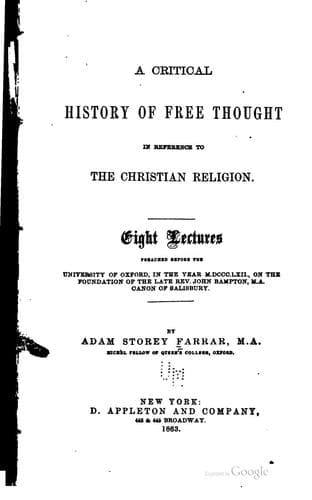
History of Free Thought in Reference to The Christian ReligionFarrar, Adam Storey
History
History of Free Thought in Reference to The Christian Religion
Farrar, Adam Storey
Free thought -- History
To qualities which were thus in some sense formed in him by circumstances,
he added remarkable ones which were Nature’s special gift to him. His
extraordinary tact and good sense, both in dealing personally with
individuals and in literary criticism; his fiery ardour, and vehement
spirit of proselytism; his singular penetration of vision, and power to
arrange in the clearest mode the thoughts which he wished to transmit;
above all, his wit and wonderful power of satire were qualities which,
though in some degree shared by his countrymen, cannot be explained by
mere circumstances, but are natural gifts. These three intellectual
endowments, acuteness, order, and satire,(525) are regarded by the
authority that we are taking for our guide, as the qualities which formed
the secret of his power as a writer, and at the same time as the sources
of intellectual temptation which prevented him from gaining a deeper
insight into truth, and deprived him of influence with posterity. For his
quickness prevented the exercise of the reflection, the patient
meditation, which is the only high road to solve the mysteries of
existence. It has been well said,(526) that Voltaire saw so much more
deeply at a glance than other men, that no second glance was ever given by
him. His power of order assisting his quickness, was a still further
temptation. Though far inferior in erudition to some of his
contemporaries, such as Diderot, and in depth of feeling to Rousseau,
lacking originality, and borrowing most of his philosophical thoughts at
second hand, he yet surpassed them all by a matchless power of
arrangement. The perfection of form diverted attention from the subject
matter. He possessed method rather than genius, intellect rather than
imagination. But above all his other powers, his most singular gift was
his power of satire. When stimulated by a sense of injustice, or of hatred
against men or systems, it made him omnipotent in destruction. This
satirical power contributed to preclude the possession of depth of
reflection. Ridicule has an office in criticism. It is the true punishment
of folly. But it has been well observed,(527) that it is dangerous to him
who employs it, as being directly opposed to humility. The satirist places
himself above that which he ridicules, and makes himself the judge: the
humility of the listener is laid aside; the selfish belief of his own
infallibility is fostered; forbearance and sympathy are laid aside. The
critic argues, the satirist only laughs. Pity may be compatible with
humour, but only contempt with satire. Voltaire was by nature a satirist;
and when his mockery was applied to a subject like Christianity or
religion, his utter want of reverence not only caused him to substitute a
caricature for a picture, but prevented him from exercising discrimination
in distinguishing Christianity from its counterfeit, religion from the
ministers of it. Hence his attacks on Christianity partake of the tone of
Public-domain text, read in full here on John Shaqi.
Reviews
Reviews
No reviews yet
Be the first to share your thoughts on this work.
Elsewhere in the archive
Join the Discussion
Join the discussion
Sign in to leave a comment or review.
Sign InorCreate an account