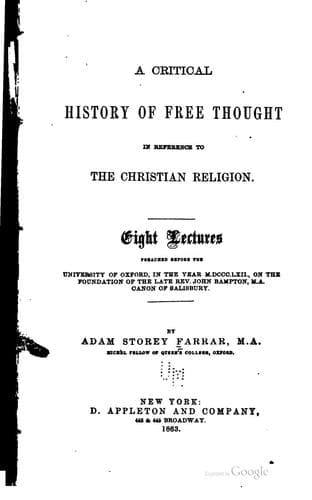
History of Free Thought in Reference to The Christian ReligionFarrar, Adam Storey
History
History of Free Thought in Reference to The Christian Religion
Farrar, Adam Storey
Free thought -- History
It is not unusual, in those who have no taste for speculation, and who
understand only the prosaic, though in some respects the truer, philosophy
of Scotland, to despise the great systems of German speculation. Yet, if
the series be measured as an example of the power of the human mind,
whatever may be the opinion formed in respect to its correctness, it
stands among the most interesting efforts of thought. Though the writers
can be matched by isolated examples in former ages, perhaps no series of
writers exists, hardly even the Greek, certainly not the Neo-Platonist nor
the Cartesian, which, in far-reaching penetration, in minuteness of
analysis, in brilliancy of imagination, in loftiness of genius, in poetry
of expression, in grasp of intellect, in influence on every branch of
thought or life, approximates to the series of illustrious thinkers which
commenced with Kant and ended with Hegel.(731) The two philosophers at
this time whose teaching formed a new influence, were Fichte(732) and
Jacobi.(733) Details in reference to their systems must be sought
elsewhere.(734) It is only possible here to indicate their central
thought, in order to notice their effects on theological inquiry.
We have seen that Kant had reconsidered the great problem, commenced by
Descartes and Locke, concerning the ground of certitude, and the nature of
knowledge; and had revolutionised philosophy, by attributing to the
natural structure of the mind many of those ideas which had usually been
supposed to be derived from experience. In his system he had left two
elements, a formal and a material; the formal, or innate forms, through
which the mind gains knowledge, and the material, presented from external
sources. It was the former or ideal element which was examined by Fichte;
the latter by Jacobi.
Fichte began to teach at Jena soon after 1790. Grasping firmly Descartes’
principle, “Cogito, ergo sum,” he conceived that, as we can only know
ourselves, there is no proof that the datum supposed to be external is
anything but a form of our own consciousness; and thus he arrived at a
subjective idealism not unlike that of bishop Berkeley.(735) Under his
view God was only an idea or form of thought; a regulative principle of
human belief, the moral order of which the mind was conscious in the
universe; and, as atheism was suspected to follow as an inference from his
views, he became the subject of persecution. But the instincts of the
heart, as well as the arguments of the understanding, were too potent for
him; and when he had thus as it were shut up man within the circle of his
own finite self, he strove to find a logical passage into a knowledge of
the infinite by a principle analogous to that of Spinoza; viz. by
regarding both self and the outer world, the subjective and objective, to
be identified in some absolute self-existence, of which they were
respectively phases.(736)
Public-domain text, read in full here on John Shaqi.
Reviews
Reviews
No reviews yet
Be the first to share your thoughts on this work.
Elsewhere in the archive
Join the Discussion
Join the discussion
Sign in to leave a comment or review.
Sign InorCreate an account