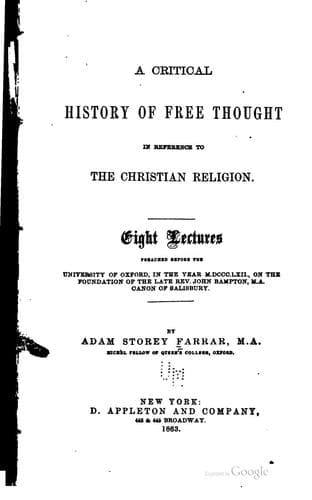
History of Free Thought in Reference to The Christian ReligionFarrar, Adam Storey
History
History of Free Thought in Reference to The Christian Religion
Farrar, Adam Storey
Free thought -- History
These philosophies, of Fichte, Schelling, and Jacobi, formed one class of
influences, which were operating about the beginning of the century, and
were the means of redeeming alike German literature and theology. Their
first effect was to produce examination of the primary principles of
belief, to excite inquiry; and, though at first only reinforcing the idea
of morality, they ultimately drew men out of themselves into aspirations
after the infinite spirit, and developed the sense of dependence, of
humility, of unselfishness, of spirituality. They produced indeed evil
effects in pantheism and ideology;(740) but the results were partial, the
good was general. The problem, What is truth?—was through their means
remitted to men for reconsideration; and the answers to it elicited, from
the one school,—It is that which I can know:—from the other,—It is that
which I can intuitively feel:—threw men upon those unalterable and
infallible instincts which God has set in the human breast as the
everlasting landmarks of truth, the study of which lifts men ultimately
out of error.
These systems had even a still more direct effect on the public mind. They
were the means of creating a literature, which insinuated itself into
public thought, and familiarised society with spiritual apprehensions long
obliterated. The school of literature commonly called the Romantic,(741)
commencing with such writers as Schlegel and Novalis, fanciful as it may
in some respects seem to be, created the same change in the belief and
tastes of the German mind as the contemporary school of Lake Poets in
England. The German literature bore the marks either of the old
scholasticism, or of the materialism introduced from France, or of the
classic culture introduced by Lessing and his coadjutors. The element now
revived was the mediæval element of chivalry, the high and lofty courage,
the delicate æsthetic taste, which had marked the middle ages.
Herder,(742) to whom Germany owes much, disgusted with the stoical and
analytic spirit of the Kantian philosophy, had already attempted, and not
in vain, to throw the mind back to an appreciation of old history, and
especially had manifested an enthusiastic admiration of Hebrew literature;
but now, as if by one general movement, the public taste was turned to an
appreciation of the freshness of feeling, and fine elements of character,
which existed in the Christianity of the middle ages.(743)
Public-domain text, read in full here on John Shaqi.
Reviews
Reviews
No reviews yet
Be the first to share your thoughts on this work.
Elsewhere in the archive
Join the Discussion
Join the discussion
Sign in to leave a comment or review.
Sign InorCreate an account