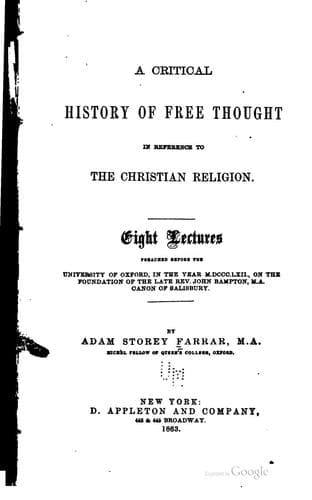
History of Free Thought in Reference to The Christian ReligionFarrar, Adam Storey
History
History of Free Thought in Reference to The Christian Religion
Farrar, Adam Storey
Free thought -- History
Bruno Bauer,(832) a Professor at Berlin, by turning suddenly round from
the most orthodox to the most heterodox position in his school, may be
classed with Strauss in his method, though not in his spirit. He carried
out Strauss’s critical examination of the Gospels with a coarse ridicule;
and extended it by denying the historic basis of fact, and imputing the
myth to the personal creation of the individual writer. But his successors
advanced even farther. As Bauer developed the critical side of Strauss,
Feuerbach(833) and Ruge(834) developed the philosophical, and destroyed
the very idea of religion itself, by showing that the idea of God or of
religion is of human construction, the giving objective existence to an
idea. The aspiration, instead of guaranteeing the existence of an object
toward which it is directed, is represented as creating it. This was the
final result of the subjective point of view of the Kantian philosophy,
and of the idealism of Hegel. Reason must, it was pretended, be followed,
to whatever extent it contradicts the feelings. Theology becomes
anthropology; religion, mythology; pantheism, atheism; man, collective
humanity, becomes the sole object of the belief and respect which had been
previously given to Deity; religion vanishes in morality. The love of man
becomes the substitute for the love of God. This was a position analogous
to that which positivism reached in France, but from a mental instead of a
physical point of view. This form of thought found expression in
literature through the poetry of Heine,(835) and linked itself with
political theories of communism more extreme than the contemporary ones in
France.
Still the lowest point was not reached: religion was treated as a
psychological peculiarity, and the virtue of benevolence recognised. But
when religion was felt to be only an idea, and the belief of the
supernatural to be the great obstacle to political reform, an intense
feeling of antipathy was aroused; and Schmidt,(836) under the pseudonym of
Stirner, reached the naturalistic point of view held by Volney, the
worship of self-love. This new school, which had arisen in the few years
subsequent to Strauss’s work, mingled itself with the revolutionary
movements of Germany in 1848, and was the means of exciting the alarm
which caused the suppression of them. Since that date the school has been
extinct as a literary movement.
Public-domain text, read in full here on John Shaqi.
Reviews
Reviews
No reviews yet
Be the first to share your thoughts on this work.
Elsewhere in the archive
Join the Discussion
Join the discussion
Sign in to leave a comment or review.
Sign InorCreate an account