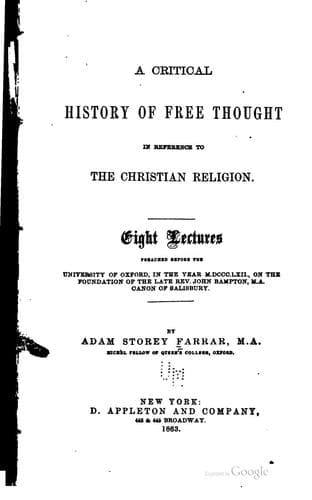
History of Free Thought in Reference to The Christian ReligionFarrar, Adam Storey
History
History of Free Thought in Reference to The Christian Religion
Farrar, Adam Storey
Free thought -- History
In the remainder of this lecture we shall carry on the history of free
thought in France, from the point at which we left it(865) down to the
present time. We shall find that the open attacks on Christianity of
former times have ceased. There, as elsewhere, the present century has
been constructive of belief in spiritual realities, not destructive; but
the reconstruction has in some cases been so connected with an abnegation
of revelation, that it merits some notice in a history of free thought.
The speculative thought in France during the present century has
manifested itself chiefly under four forms:(866) (1) a sensational school,
called in the early part of the century Ideology, in the latter
Positivism: (2) a theological school, which has attempted to re-establish
a ground for reposing on dogmatic authority: (3) a social philosophy,
which has directed itself to the study of society and labour: and (4) the
eclectic philosophy, created by German thought, which has sought to
reconstruct truth on the basis of psychology. The chronological sequence
of these schools connects itself with the political sequence of events,
and has altered with their change. We must trace them briefly in
succession, in order to understand their religious influence and
tendencies. The first has tended directly to atheism, the second to
superstition, the two last indirectly to pantheism.
When treating of Volney in a former lecture, we noticed the philosophy
which took its rise amid the ruins caused by the revolution. Christianity
was replaced by materialism, theism by atheism, ethics by selfishness. The
philosophy of Cabanis, of Volney, and of De Tracy,(867) was founded so
entirely on a physical view of human nature, that it could hardly aid in
any way in instilling nobler conceptions. Society grew up without the
belief of God or immortality; but in this very poverty the system met its
downfall. The deep yearnings of the human heart craved satisfaction. The
inextinguishable poetry of the soul yearned for the spiritual; the
devotional instincts of human nature caught the first notes of that
heavenly melody to which they were naturally fitted to be attuned.
Public-domain text, read in full here on John Shaqi.
Reviews
Reviews
No reviews yet
Be the first to share your thoughts on this work.
Elsewhere in the archive
Join the Discussion
Join the discussion
Sign in to leave a comment or review.
Sign InorCreate an account