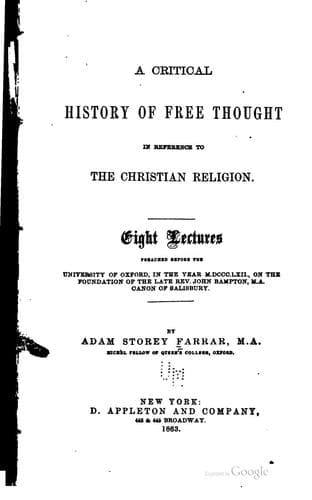
History of Free Thought in Reference to The Christian ReligionFarrar, Adam Storey
History
History of Free Thought in Reference to The Christian Religion
Farrar, Adam Storey
Free thought -- History
The life and work of the former, so far as they relate to our inquiries,
may soon be told.(950) In early life a unitarian minister, he caught the
spirit of intellectual inquiry and reconsideration which Channing had
excited; and devoted himself with indefatigable industry to study the
modern philosophy and criticism of Germany, until he became one of the
most learned men of the American continent. In his own country his
fearless and uncompromising denunciation of slavery, as well as of
political and commercial hollowness, caused him to be viewed as a social
reformer rather than a theological teacher. In ours he is viewed as a
teacher of deism. The cause of his power is obvious. Feeling that his
mission was not merely to pull down, but to build up, he spoke with the
vigour of a dogmatist, not with the coldness of a critic. To a burning
eloquence and native wit he united the picturesque power of the novelist
or the artist. But his vigour of style was deformed by a power of sarcasm
which often invested the most sacred subjects with caricature and
vulgarity; a boundless malignity against supposed errors. How different is
the tone of his satire from the delicate touches of the modern French
critic(951) who was named in the last lecture! and yet, on the other hand,
how changed from that of the infidel writers of the last century. Though
he equals Paine in vulgarity, and Voltaire in sarcasm, his spirit and
moral tone are higher. They wrote, actuated by a bitter spirit against the
Christian religion, without earnestness, without religious aspirations,
with the coldness of unbelievers: he, with the earnestness of a preacher
touched with the deepest feelings; and though the Christian writer will
shudder at his remarks as much as at theirs, yet he sees them modified by
passages of pathetic sentiment, in which, in words unrivalled in sceptical
literature, admiration is expressed of Christ, of Christianity, and of
scripture.(952)
Such was the man as a teacher. What was his doctrine? He sought and found
in the human faculties the test of truth, not dwelling, like Strauss, on
their tendency to deceive; but, like Schelling, on their certitude. He
placed the ground of religion on the emotional side of the soul, in the
feeling of dependence;(953) and correctively, on the intellectual side, in
the intuitions of God, the moral law, and immortal life.
Public-domain text, read in full here on John Shaqi.
Reviews
Reviews
No reviews yet
Be the first to share your thoughts on this work.
Elsewhere in the archive
Join the Discussion
Join the discussion
Sign in to leave a comment or review.
Sign InorCreate an account