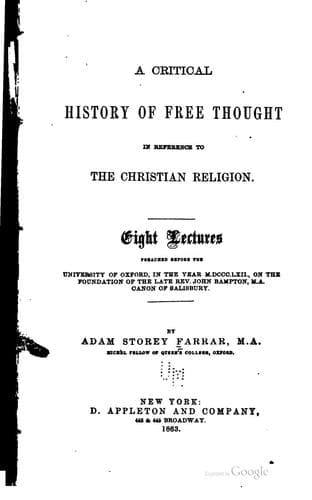
History of Free Thought in Reference to The Christian ReligionFarrar, Adam Storey
History
History of Free Thought in Reference to The Christian Religion
Farrar, Adam Storey
Free thought -- History
The destructive side of his teaching is conveyed in the narrative of the
“Phases” of his faith. Educated in the tenets of the more spiritual
section of the church, he gradually began, as he has stated, to reconsider
his opinions as his mind was awakened by study. The moral identity of
Sabbath and Sunday; the practice of infant baptism; the connexion of a
spiritual effect with what he considered to be a material cause implied in
baptismal regeneration; the reasons for the superior efficacy of Christ’s
sacrifice over the Mosaic; the discovery of gradual development in
scripture; these were the first thoughts that agitated him.(961) Unable to
solve them to his satisfaction, he hesitated not to abandon, with noble
and manly self-sacrifice, the friends that he held dear; and to wander
forth from the established church, to seek a primitive Christianity
elsewhere. Puzzled by the difficulty of the supposed mistake of the
apostolic church, in expecting the sudden return of Christianity, he
adopted the chiliastic hypothesis; and, unable to join in ministerial work
in England, went as a missionary into the East.(962) On his return,
alienated from the friends of his youth and from the new instructors with
whom he had consorted, he sought truth in the solitude of his own heart;
and was led to throw off Calvinism and adopt Unitarianism.(963) His fourth
phase of faith led him, while clinging to Christianity, to renounce the
religion of the Book. It consisted in an examination of many of the
difficulties which criticism has discovered; from which he was unhappily
led to conclude that the Bible was not free from error, nor above moral
criticism;(964) believing nevertheless that the Bible was made for man,
though not man for the Bible. The two concluding phases of his faith(965)
consisted in appreciating the great law of progress which he considers to
mark religion; and discovering that faith at second hand is vain, and that
the historical truthfulness of Christianity is unimportant, the ideas
embodied in it constituting its truth.(966)
Public-domain text, read in full here on John Shaqi.
Reviews
Reviews
No reviews yet
Be the first to share your thoughts on this work.
Elsewhere in the archive
Join the Discussion
Join the discussion
Sign in to leave a comment or review.
Sign InorCreate an account