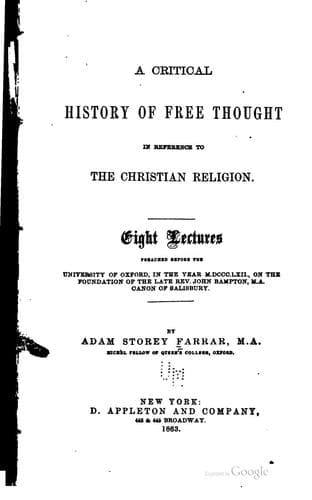
History of Free Thought in Reference to The Christian ReligionFarrar, Adam Storey
History
History of Free Thought in Reference to The Christian Religion
Farrar, Adam Storey
Free thought -- History
Hence, when applied to revealed religion, in examining the teaching of the
scripture writers, it does not attempt, as the former school, to raise the
mind to a level with that of the writers, in order to apprehend the
eternal truth which was revealed alike to their intuition and to ours; but
it throws itself into the circumstances of their age, so as to understand
their meaning; and tests it by the altered conceptions which the progress
of ages has given to the world. Thus the inquirer not only asks what the
writers meant, but views the truth which they taught as relative to their
own age; and regards the office of criticism to be, to discriminate in it
that which is conceived to have been temporary and local, and that which
applies to all time. This school thus resembles the last, in asking what
the scripture writers meant in their own time, and what their meaning is
to us; but it seeks the answer, by using the same methods for the
investigation which would be applied in ordinary literature; not by
abstract speculation, apart from literary study of actual documents. It
makes the conceptions which civilization and history have created, to be
the test for comparison, not the eternal truths of reason which are
supposed to exist irrespective of civilization and history.
We may select one illustration. In surveying the doctrine of the atoning
work of Christ, the former school seeks to apprehend the absolute meaning
of the atonement as the manifestation of an act previously wrought out;
and, starting with the notion of the divine teacher of humanity, the Λόγος
of God in Christ teaching the world, and the Λόγος in the soul of man
apprehending this teaching, it construes the atoning work of Christ from
its didactic side, as teaching man concerning God’s love by means of a
majestic example of self-sacrifice. The second school treats the doctrine
historically; and, when it has separated the apostolic teaching from all
subsequent additions, compares this doctrine with the age in which it was
expressed, in order to separate what it conceives to be the permanent from
the temporary; and hence comes to view the atonement, apart from all the
hallowed associations of propitiatory sacrifice which in the minds of the
early converts were inseparably united with it. These ideas, which the
doctrine of the church regards as integral portions of revealed verity, it
considers to be the peculiarity of the age in which the revelation was
communicated. The revealed doctrines are handled in the same manner as
corresponding doctrines of philosophy.
Public-domain text, read in full here on John Shaqi.
Reviews
Reviews
No reviews yet
Be the first to share your thoughts on this work.
Elsewhere in the archive
Join the Discussion
Join the discussion
Sign in to leave a comment or review.
Sign InorCreate an account