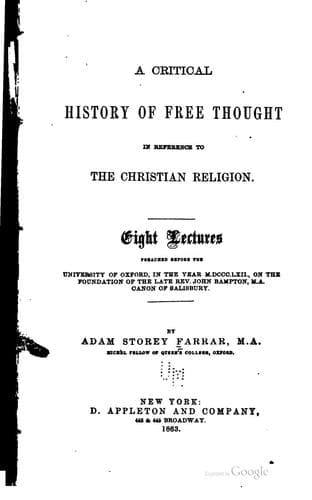
History of Free Thought in Reference to The Christian ReligionFarrar, Adam Storey
History
History of Free Thought in Reference to The Christian Religion
Farrar, Adam Storey
Free thought -- History
The history of recent doubt has brought before us some whose minds doubt
wholly of the supernatural. In the case of a few of these, but only of a
few, the doubt has passed into positive unbelief; their convictions have
become so fixed that they manifest a fierce spirit of proselytism, and can
dare to point the finger of scorn at those who still believe in the unseen
and supernatural relations of God to the human soul. Between these and
religious men the struggle is internecine. We can have no sympathy with
them: we can rejoice that they retain a moral standard, where they have
rejected many of the most potent motives which support it; but must
tremble lest their unbelief end in thorough animalism; lest Epicureanism
be their final philosophy. But there are many more whose tone is that of
sadness, not of scorn; the temper of Heracleitus, not Democritus; whose
souls feel the longing want which nothing but communion with a Father in
heaven can supply, but who are so clouded with doubt, and retain so faint
a hold on the thought of God’s interference, and on the reality of the
supernatural, that they are unable to soar on the wings of faith beyond
the natural, either material or spiritual, up to the throne of God.
The history of such men generally tells of some mighty mental convulsion,
which has driven them from their anchor-ground of belief. Sometimes the
study of science, as it is seen gradually to absorb successive ranges of
phenomena into the regular operation of universal law, until it removes
God far away, and creation seems to move on without His interference, has
been the cause:—in other cases philanthropic pity, musing on the sad
catastrophes which daily occur, when the happiness and lives of innocent
human beings are for ever destroyed by the stem unyielding action of
nature’s laws, leading the heart to doubt God’s nearness, and the fact of
a special Providence:—in other cases again, the study of the human mind in
history, and the perception of the manner in which the gradual growth of
knowledge seems to lessen the region of the supernatural, until the mind
doubts whether the supernatural itself is not the mere _idolum tribûs_, a
mere giving objective being to a subjective idea, a truth relative merely
to a particular stage of civilization. Such causes as these, producing a
convulsion of feeling, may form the sad occasion from which the soul dates
its loss of the grasp which it has heretofore had over the belief of God’s
nearness, and of religion; and mark the moment from which it has gradually
doubted whether anything exists save eternal law; or whether a personal
Deity, if he exist, really communes with man; whether, in short, religion
be anything but duty, and Christianity anything but the noble type of it
to which one branch of the Semitic people was happy enough to attain.
Public-domain text, read in full here on John Shaqi.
Reviews
Reviews
No reviews yet
Be the first to share your thoughts on this work.
Elsewhere in the archive
Join the Discussion
Join the discussion
Sign in to leave a comment or review.
Sign InorCreate an account