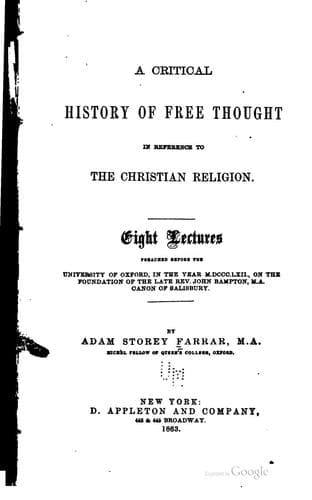
History of Free Thought in Reference to The Christian ReligionFarrar, Adam Storey
History
History of Free Thought in Reference to The Christian Religion
Farrar, Adam Storey
Free thought -- History
Yet, when we have used all methods of argument which the survey of the
history has given us reason to believe may prove useful, it were
affectation to conceal our belief in the perpetual operation, secret and
unobserved, of an invisible monitor and persuader, the blessed Spirit of
God. Though we may look to philosophy to prepare the way, by exciting an
appreciation of the wants which Christianity supplies, and an apprehension
of the suitability of Christianity as the perfection of our spiritual
nature; we must confess that it is to the unseen leadings of the Spirit of
God that we trust, to make the heart feel the truth as well as perceive
it, and love as well as appreciate it. If we accept the fact of God’s
interference to effect man’s salvation, and regard it as His special will
to bring men to the knowledge of Christ, and trust His promise of
assistance to the church,(1050) it is not enthusiasm, but the most
rational faith, to expect divine assistance to attend constantly on the
efforts made to spread the truth which He has been pleased to reveal; not
to interfere indeed with the fixed laws of the rational faculties, but to
remove prejudices of the heart which might blind the apprehension, and to
hallow the soul into a temple for the enshrinement of His truth.
More especially if it be true, as we have perpetually insisted, that there
is a large region for the influence of emotional causes of doubt, in
addition to the intellectual, which have been the subject of our special
study, we may well believe that here is a field where the Holy Spirit
alone can enter, and in which He only has the power to operate. Evidence,
as evidence, is apprehended and tested by the intellectual faculties; but
whatever is the subtle influence, consciously or unconsciously exercised
by the emotions, in a matter where the evidence is probable, not
demonstrative, this offers a sphere where the help of an all-loving God
may be hoped for to dissipate the alienation of prejudice or indifference.
Paul may plant, and Apollos may water; but it is God that giveth the
increase.
We have now considered the lessons taught by the history, both as to the
moral function of free thought, the forms of it which are most likely to
meet Christians in the present day, and the means which seem most useful
for guiding a doubter into truth.
-------------------------------------
The history may teach a final lesson to us as Christian students, not so
much in reference to leading others to truth, as in relation to the means
by which we can attain it ourselves.
Public-domain text, read in full here on John Shaqi.
Reviews
Reviews
No reviews yet
Be the first to share your thoughts on this work.
Elsewhere in the archive
Join the Discussion
Join the discussion
Sign in to leave a comment or review.
Sign InorCreate an account