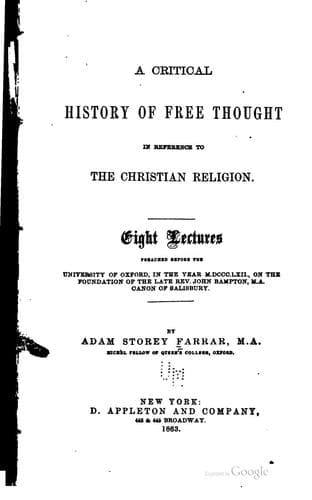
History of Free Thought in Reference to The Christian ReligionFarrar, Adam Storey
History
History of Free Thought in Reference to The Christian Religion
Farrar, Adam Storey
Free thought -- History
The rival system of proof founded in intuitive consciousness is however
not free from danger. A difference occurs, according as this endowment is
regarded as merely revealing the facts of our own inner experience, or on
the other hand as possessing a power to apprehend God positively, and
spirit to spirit.(102) The result of the former belief would be indeed an
ethical religion, compared with the political one just described. If it
did not rise from the law to the law-giver, it would at least present
morality as a law obligatory on man by his mental structure, independently
of the consideration of reward and punishment. The ideas of God, duty,
immortality, would be established as a necessity of thought, if not as
matters of objective fact. Yet religion would be rather rational than
supernatural; obedience to duty instead of communion with Deity; and
unless the mind can find ground for a belief in God and the divine
attributes through some other faculty, the idealism must destroy the
evidence of revealed religion. Or at least, if the mind admit its truth,
it must renounce the right to criticise the material of that which it
confesses to be beyond the limits of its own consciousness; and thus, by
abdicating its natural powers, blindly submit to external authority, and
accept belief as the refuge from its own Pyrrhonism.
If, on the other hand, instead of regarding all attempts to pass beyond
logical forms of thought to be mental impotence, the mind follows its own
instincts, and, relying upon the same natural realism which justifies its
belief in the immediate character of its sensitive perceptions, ventures
to depend with equal firmness on the reality of its intuitional
consciousness, religion, natural or revealed, wears another aspect; and
both the advantages and the dangers of such a view are widely
different.(103) The soul no longer regards the landscape to be a scene
painted on the windows of its prison-house, a subjective limit to its
perceptions, but not speculatively true; but it wanders forth from its
cell unfettered into the universe around. God is no longer an inference
from final causes, nor a principle of thought. He is the living God, a
real personal spirit with whom the soul is permitted to hold direct
communion. Providence becomes the act of a personal agent. Religion is the
worship in spirit. Sin is seen in its heinousness. Prayer is justified as
a reality, as the breathing of the human soul for communion with its
infinite Parent (8). And by the light of this intuition, God, nature, and
man, look changed. Nature is no longer a physical engine; man no longer a
moral machine. Material nature becomes the regular expression of a
personal fixed will; Miracle the direct interposition of a personal free
will. Revelation is probable, as the voice of God’s mercy to the child of
His love. Inspiration becomes possible, for the intuitional consciousness
seems adapted to be used by divine Providence as its instrument.(104)
Public-domain text, read in full here on John Shaqi.
Reviews
Reviews
No reviews yet
Be the first to share your thoughts on this work.
Join the Discussion
Join the discussion
Sign in to leave a comment or review.
Sign InorCreate an account