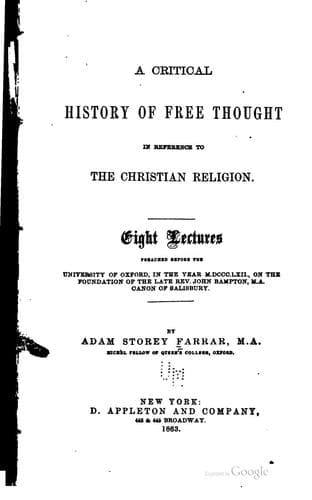
History of Free Thought in Reference to The Christian ReligionFarrar, Adam Storey
History
History of Free Thought in Reference to The Christian Religion
Farrar, Adam Storey
Free thought -- History
But the type of mind created by the use of intuition as a test of truth is
rarely alone. It is cognate to, if it is not connected with, that produced
by the third of the above-named tests, feeling. The emotions, according to
a law of spiritual supply and demand, suggest the reality of the objects
toward which they are aspirations. The longing for help, the feeling of
dependence, is the justification of prayer; the sense of remorse is the
witness to divine judgment; the consciousness of penitence is the ground
for hope in God’s merciful interference; the ineradicable sense of guilt
is the eternal witness to the need of atonement; the instinct for
immortality is the pledge of a future life.
Yet the use of these tests of intuition and feeling in religion, though
possessing these advantages, has dangers. If the feelings, instead of
being used to reinforce or check the other faculties, be relied upon as
sole arbiters; especially if they be linked with the imagination instead
of the intuition; they may conduct to mysticism and superstition by the
very vividness of their perception of the supernatural.(105) Likewise the
intuitive faculty, if it be regarded as giving a noble grasp over the fact
of God as an infinite Spirit, may cause the mind to relax its hold on the
idea of the Divine Personality, and fall into Pantheism, and identify God
with the universe, not by degrading spirit to matter, but by elevating
matter to spirit.(106) Or, instead of allowing experience and revelation
to develop into conceptions of the fundamental truth whose existence it
perceives, it may attempt to develop a religion wholly _à priori_,(107)
and assert its right to create as well as to verify. Also, when applying
itself to revealed religion, this type of thought necessarily makes its
last appeal to inward insight. It cannot, like sensationalism, or
subjective idealism, admit its own impotence, and receive on authority a
revelation, the contents of which it ventures not to criticise. It must
always appropriate that which it is to believe. Accordingly it will have a
tendency to render religion subjective in its character, uncertain in its
doctrines, individual in its constitution.
These general remarks, every one of which admits of historic
exemplification,(108) will suffice to illustrate the kind of influence
exercised by these respective tests of truth in forming the judgment or
moulding the character in relation to the belief or disbelief of natural
and revealed religion. These effects are not adduced as the necessary
results but as the ordinary tendencies of these respective theories. The
mind frequently stops short of the conclusions logically deducible from
its own principles. To measure precisely the effect of each view would be
impossible. In mental science analysis must be qualitative, not
quantitative.
Public-domain text, read in full here on John Shaqi.
Reviews
Reviews
No reviews yet
Be the first to share your thoughts on this work.
Join the Discussion
Join the discussion
Sign in to leave a comment or review.
Sign InorCreate an account