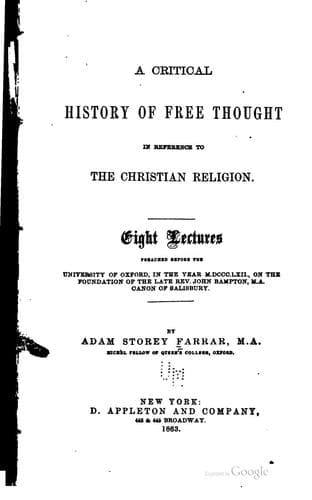
History of Free Thought in Reference to The Christian ReligionFarrar, Adam Storey
History
History of Free Thought in Reference to The Christian Religion
Farrar, Adam Storey
Free thought -- History
It will hardly be expected that we should arbitrate among these theories,
inasmuch as our purpose is not to test the comparative truthfulness of
metaphysical opinions, but to refer sceptical opinions in religion to
their true scientific and metaphysical parentage. Truth is probably to be
found in a selection from all; and historical investigation is the chief
means of discovering the mode of conducting the process. It is at least
certain, that if history be the form which science necessarily takes in
the study of that which is subject to laws of life and organic growth, it
must be the preliminary inquiry in any investigation in reference to
mental phenomena. The history of philosophy must be the approach to
philosophy.(109) The great problem of philosophy is method; and if there
be a hope that the true method can ever be found it must be by uniting the
historical analysis of the development of the universal mind with the
psychological analysis of the individual. The history of thought indicates
not only fact but truth; not only shows what has been, but, by exhibiting
the proportions which different faculties contribute toward the
construction of truth, and indicating tendencies as well as results,
prepares materials to be collated with the decision previously made by
mental and moral science concerning the question of what ought to be (9).
A definite conviction on this metaphysical inquiry seems perhaps to be
involved in the very idea of criticism, and necessary for drawing the
moral from the history; yet the independence of our historical inquiry
ought to be sacrificed as little as possible to illustrate a foregone
conclusion. It will be more satisfactory to present the evidence for a
verdict without undue advocacy of a side in the metaphysical
controversy.(110)
The execution of this design of analysing the intellectual causes of
unbelief will necessarily involve to some extent a biographical treatment
of the subject, both for theoretical and practical reasons, to discover
truth and to derive instruction. This is so evident in the history of
action, that there is a danger at the present time lest history should
lose the general in the individual, and descend from the rank of science
to mere biography.(111) The deeper insight which is gradually obtained
into the complexity of nature, together with the fuller conviction of
human freedom, is causing artistic portraiture and ethical analysis to be
substituted for historical generalization. The same method however applies
to the region of thought as well as will.
Public-domain text, read in full here on John Shaqi.
Reviews
Reviews
No reviews yet
Be the first to share your thoughts on this work.
Join the Discussion
Join the discussion
Sign in to leave a comment or review.
Sign InorCreate an account