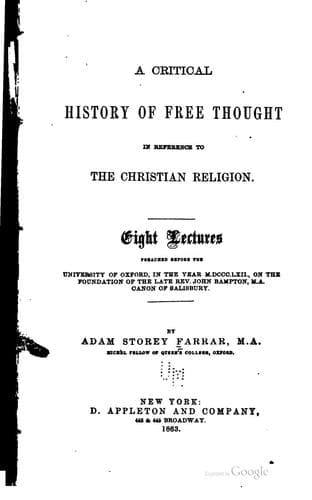
History of Free Thought in Reference to The Christian ReligionFarrar, Adam Storey
History
History of Free Thought in Reference to The Christian Religion
Farrar, Adam Storey
Free thought -- History
Indeed biographical notices, if they could be extended compatibly with the
compass of the subject, would be the most instructive and vivid mode of
presenting alike the facts relating to scepticism and their
interpretation. Such memoirs are not wanting, and are among the most
touching in literature. The sketch which Strauss has given of his early
friend and fellow student Maerklin,(113) gradually surrendering one
cherished truth after another, until he doubted all but the law of
conscience; then devoting himself in the strength of it with unflinching
industry to education; until at last he died in the dark, without belief
in God or hope, cheered only by the consciousness of having tried to find
truth and do his duty:—the sad tale, told by two remarkable biographers,
of Sterling,(114) doubting, renouncing the ministry, yet thirsting for
truth, and at last solacing himself in death by the hopes offered by the
Bible, to the eternal truths of which his doubting heart had always
clung:—the memoir of the adopted son of our own university, Blanco
White,(115) a mind in which faith and doubt were perpetually waging war,
till the grave closed over his truth-searching and care-worn spirit:—the
confessions of one of our own sons of the successive “phases of
faith”(116) through which his soul passed from evangelical Christianity to
a spiritual Deism, a record of heart-struggles which takes its place among
the pathetic works of autobiography, where individuals have unveiled their
inner life for the instruction of their fellow-men:—all these are
instances where the great moral and spiritual problems that belong to the
condition of our race may be seen embodied in the sorrowful experience of
individuals. They are instances of rare value for psychological study in
reference to the history of doubt; sad beacons of warning and of guidance.
Accordingly, in the history of free thought we must not altogether neglect
the spiritual biography of the doubter, though only able to indicate it by
a few touches; by an etching, not a photograph.
We have now added to the explanation before given of the province of our
inquiry, and of the law of the action of free thought on religion, an
account of the moral and intellectual causes which operate in the history
of unbelief, and have sufficiently explained the mode in which the subject
will be treated.
The use of the inquiry will, it is hoped, be apparent both in its
theoretical and practical relations. It is designed to have an
intellectual value not only as instruction but as argument. The tendency
of it will be in some degree polemical as well as didactic, refuting error
by analysing it into its causes, repelling present attacks by studying the
history of former ones.
Public-domain text, read in full here on John Shaqi.
Reviews
Reviews
No reviews yet
Be the first to share your thoughts on this work.
Join the Discussion
Join the discussion
Sign in to leave a comment or review.
Sign InorCreate an account