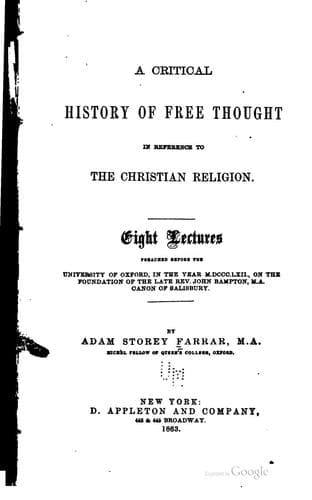
History of Free Thought in Reference to The Christian ReligionFarrar, Adam Storey
History
History of Free Thought in Reference to The Christian Religion
Farrar, Adam Storey
Free thought -- History
It is one peculiar advantage belonging to the philosophical investigation
of the history of thought, that even the odious becomes valuable as an
object of study, the pathology of the soul as well as its normal action.
Philosophy takes cognisance of error as well as of truth, inasmuch as it
derives materials from both for discovering a theory of the grounds of
belief and disbelief. Hence it follows that the study of the natural
history of doubt combined with the literary, if it be the means of
affording an explanation of a large class of facts relating to the
religious history of man and the sphere of the remedial operations of
Christ’s church, will have a practical value as well as speculative.
Such an inquiry, if it be directed, as in the present lectures, to the
analysis of the intellectual rather than the emotional element of
unbelief, as being that which has been less generally and less fully
explored, will require to be supplemented by a constant reference to the
intermixture of the other element, and the consequent necessity of taking
account of the latter in estimating the whole phenomenon of doubt. But
within its own sphere it will have a practical and polemical value, if the
course of the investigation shall show that the various forms of unbelief,
when studied from the intellectual side, are corollaries from certain
metaphysical or critical systems. The analysis itself will have indirectly
the force of an argument. The discovery of the causes of a disease
contains the germ of the cure. Error is refuted when it is referred to the
causes which produce it.
Nor will the practical value of the inquiry be restricted to its use as a
page in the spiritual history of the human mind, but will belong to it
also as a chapter in the history of the church. For even if in the study
of the contest our attention be almost wholly restricted to the movements
of one of the two belligerents, and only occasionally directed to the
evidences on which the faith of the church in various crises reposed, and
by which it tried to repel the invader, yet the knowledge of the scheme of
attack cannot fail to be a valuable accompaniment to the study of the
defence.(117)
Thus the natural history of doubt, viewed as a chapter of human history,
like the chapter of physiology which studies a disease, will point
indirectly to the cure, or at least to the mode of avoiding the causes
which induce the disease; while the literary history of it, viewed as a
chapter of church history, will contribute the results of experience to
train the Christian combatant.
Public-domain text, read in full here on John Shaqi.
Reviews
Reviews
No reviews yet
Be the first to share your thoughts on this work.
Join the Discussion
Join the discussion
Sign in to leave a comment or review.
Sign InorCreate an account