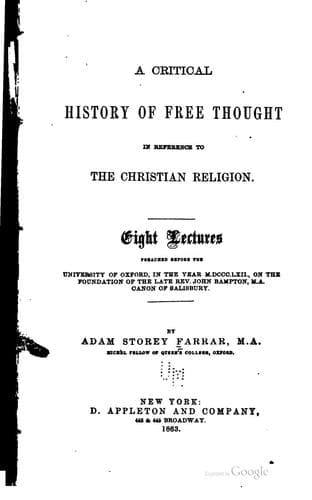
History of Free Thought in Reference to The Christian ReligionFarrar, Adam Storey
History
History of Free Thought in Reference to The Christian Religion
Farrar, Adam Storey
Free thought -- History
The subject will however not only have an intellectual value in being at
once didactic and polemical, offering an explanation of the causes of
unbelief and furnishing hints for their removal; but it cannot fail also
to possess a moral value in reference to the conscience and heart of the
disputant, in teaching the lesson of mercy towards the unbeliever, and
deep pity for the heart wounded with doubts. An intelligent acquaintance
with the many phases of history operates like foreign travel in widening
the sympathies; and increase of knowledge creates the moderation which
gains the victory through attracting an enemy instead of repelling him.
Bigotry is founded on ignorance and fear. True learning is temperate,
because discriminating; forbearing, because courageous. If we place
ourselves in the position of an opponent, and try candidly to understand
the process by which he was led to form his opinions, indignation will
subside into pity, and enmity into grief: the hatred will be reserved for
the sin, not for the sinner; and the servant of Jesus Christ will thus
catch in some humble measure the forbearing love which his divine Master
showed to the first doubting disciple.(118) As the sight of suffering in
an enemy changes the feeling of anger into pity, so the study of a series
of spiritual struggles makes us see in an opponent, not an enemy to be
crushed, but a brother to be won. The utility of a historic treatment of
doubt is suggested by moral as well as intellectual grounds.
I hope therefore that if I follow the example of some of my
predecessors,(119) in giving a course of lectures historical rather than
polemical, evincing the critic rather than the advocate, seeking for truth
rather than victory, analysing processes of evidence rather than refuting
results, my humble contribution toward the knowledge of the argument of
the Christian evidences will be considered to come fairly within the
design intended by the founder of the lecture.
Public-domain text, read in full here on John Shaqi.
Reviews
Reviews
No reviews yet
Be the first to share your thoughts on this work.
Elsewhere in the archive
Join the Discussion
Join the discussion
Sign in to leave a comment or review.
Sign InorCreate an account