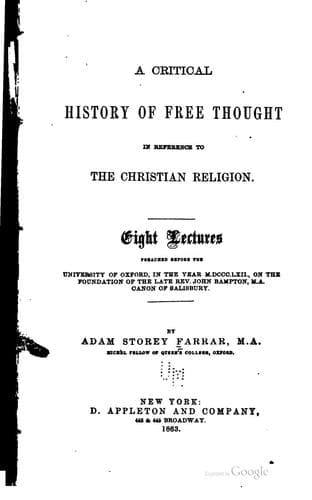
History of Free Thought in Reference to The Christian ReligionFarrar, Adam Storey
History
History of Free Thought in Reference to The Christian Religion
Farrar, Adam Storey
Free thought -- History
The truest modern resemblance to this struggle is obviously to be found in
the disbelief shown by educated heathens in pagan countries to whom
Christianity is proclaimed in the present day. It was not until the
establishment of Christianity as the state religion by Constantine had
given it political and moral victory, that it was possible for unbelief to
assume its modern aspect, of being the attempt of reason to break away
from a creed which is an acknowledged part of the national life. The first
opponents accordingly whose views we shall study, Lucian, Celsus,
Porphyry, Hierocles, are heathen unbelievers. Julian is the earliest that
we encounter who rejected Christianity after having been educated in it.
The resemblance however to this struggle is not wholly restricted to
heathen lands. There have been moments in the history of nations, or of
individuals, when a Christian standard of feeling or of thought has been
so far obliterated that a state of public disbelief and philosophical
attack similar to the ancient heathen has reappeared, and the tone of the
early unbelievers, and sometimes even their specific doubts, have been
either borrowed or reproduced.(123)
In this portion of the history we encounter a difficulty peculiar to it,
in being compelled to form an estimate of the opinions described, from
indirect information. The treatises of the more noted writers that opposed
Christianity have perished; some through natural causes, but those of
Porphyry and Julian through the special order of a Christian emperor,
Theodosius II., in A.D. 435.
In the absence accordingly of the original writings, we must discover the
grounds for the rejection of Christianity by the aid of the particular
treatises of evidence written by Christian fathers expressly in refutation
of them, which occasionally contain quotations of the lost works; and also
by means of the general apologies written on behalf of the Christian
religion, together with slight notices of it occurring in heathen
literature. The latter will inform us concerning the miscellaneous
objections current, the former concerning the definite arguments of the
writers who expressly gave reasons for disbelieving Christianity.(124)
Public-domain text, read in full here on John Shaqi.
Reviews
Reviews
No reviews yet
Be the first to share your thoughts on this work.
Elsewhere in the archive
Join the Discussion
Join the discussion
Sign in to leave a comment or review.
Sign InorCreate an account