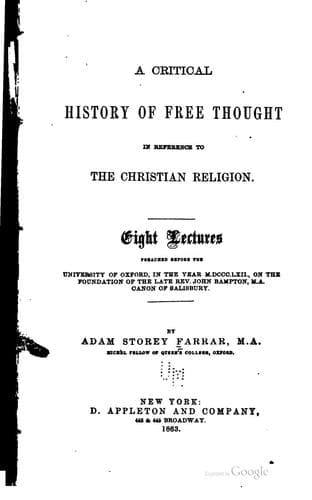
History of Free Thought in Reference to The Christian ReligionFarrar, Adam Storey
History
History of Free Thought in Reference to The Christian Religion
Farrar, Adam Storey
Free thought -- History
We possess a large treatise of Origen against Celsus; passages, directed
against Porphyry, of Eusebius, Jerome, and Augustin; a tract of Eusebius
against Hierocles; and a work of Cyril of Alexandria against Julian. Yet
it is never perfectly satisfactory to be obliged to read an opinion
through the statement of an opponent of it. The history of philosophical
controversy shows that intellectual causes, such as the natural tendency
to answer an argument on principles that its author would not concede, to
reply to conclusions instead of premises, or to impute the corollaries
which are supposed to be deducible from an opinion, may lead to
unintentional misrepresentation of a doctrine refuted, even where no moral
causes such as bias or sarcasm contribute to the result. Aristotle’s
well-known criticism of Plato’s theory of archetypes is a pertinent
illustration.(125)
The slight difficulty thus encountered, in extracting the real opinions of
the early unbelievers out of the replies of their Christian opponents, may
for the most part be avoided by first realising the state of belief which
existed in reference to the heathen religion, which for our present
purpose may be treated as homogeneous throughout the whole Roman world. We
shall thus be enabled as it were to foresee the line of opinion which
would be likely to be adopted in reference to a new religion coming with
the claims and character of Christianity. This prefatory inquiry will also
coincide with our general purpose of analysing the influence of
intellectual causes in the production of unbelief.
Four separate tendencies may be distinguished among heathens in the early
centuries in reference to religion:(126) viz. the tendency, (1) to
absolute unbelief, (2) to a bigoted attachment to a national creed, (3) to
a philosophical, and (4) a mystical theory of religion.
Public-domain text, read in full here on John Shaqi.
Reviews
Reviews
No reviews yet
Be the first to share your thoughts on this work.
Elsewhere in the archive
Join the Discussion
Join the discussion
Sign in to leave a comment or review.
Sign InorCreate an account