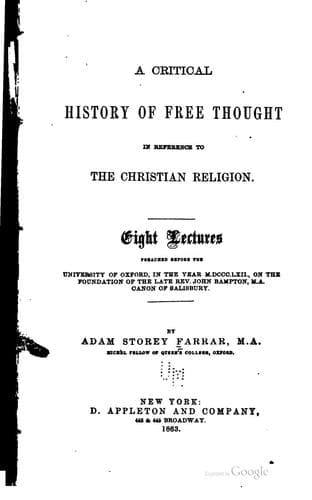
History of Free Thought in Reference to The Christian ReligionFarrar, Adam Storey
History
History of Free Thought in Reference to The Christian Religion
Farrar, Adam Storey
Free thought -- History
The tendency to total disbelief of the supernatural prevailed in the
Epicurean school. A type of the more earnest spirits of this class is seen
at a period a little earlier than the Christian era in Lucretius, living
mournfully in the moral desert which his doubts had scorched into
barrenness.(127) The world is to him a scene unguided by a Providence:
death is uncheered by the hope of a future life. An example of the
flippant sceptic is found in Lucian in the second century, A.D. The great
knowledge of life which travel had afforded him created a universal
ridicule for religion; but his unbelief evinced no seriousness, no
sadness. His humour itself is a type of the man. Lacking the bitter
earnestness which gave sting to the wit of Aristophanes, and the courteous
playfulness exhibited in the many-sided genius of Plato, he was a
caricaturist rather than a painter: his dialogues are farces of life
rather than satires. It has been well remarked, that human society has no
worse foe than a universal scoffer. Lacking aspirations sufficiently lofty
to appreciate religion, and wisdom to understand the great crises that
give birth to it, such a man destroys not superstition only but the very
faculty of belief.(128) It is easy to perceive that to such minds
Christianity would be a mark for the same jests as other creeds.
A second tendency, most widely opposed in appearance to the sceptical, but
which was too often its natural product, showed itself in a bigoted
attachment to the national religion.(129) Among the masses such faith was
real though unintelligent, but in educated men it had become artificial.
When an ethnic religion is young, faith is fresh and gives inspiration to
its art and its poetry. In a more critical age, the historic spirit
rationalizes the legends, while the philosophic allegorizes the myths; and
thoughtful men attempt to rise to a spiritual worship of which rites are
symbols.(130) But in the decay of a religion, the supernatural loses its
hold of the class of educated minds, and is regarded as imposture, and the
support which they lend to worship is political. They fall back on
tradition to escape their doubts, or they think it politically expedient
to enforce on the masses a creed which they contemn in heart. Such a
ground of attachment to paganism is described in the dialogue of the
Christian apologist, Minucius Felix.(131) It would not only coincide with
the first-named tendency in denying the importance of Christianity, but
would join in active opposition. In truth, it marks the commencement of
the strong reaction which took place in favour of heathenism at the close
of the second century,—twofold in its nature; a popular reaction of
prejudice or of mysticism on the part of the lower classes, and a
political or philosophical one of the educated.(132) Both were in a great
degree produced by Eastern influences. The substitution which was
gradually taking place of naturalism for humanism, the adoration of
Public-domain text, read in full here on John Shaqi.
Reviews
Reviews
No reviews yet
Be the first to share your thoughts on this work.
Elsewhere in the archive
Join the Discussion
Join the discussion
Sign in to leave a comment or review.
Sign InorCreate an account