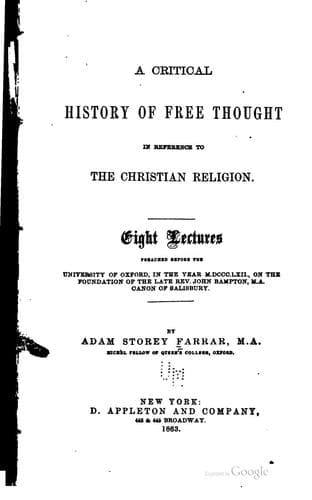
History of Free Thought in Reference to The Christian ReligionFarrar, Adam Storey
History
History of Free Thought in Reference to The Christian Religion
Farrar, Adam Storey
Free thought -- History
The line is not very marked which separates this philosophy from the
professed revival of Plato’s teaching, which received the name of
Neo-Platonism, which was the philosophy with which Christianity came most
frequently into conflict or contact during the third and two following
centuries (10). Fastening on the more mystical parts of Plato, to the
neglect of the more practical, it probably borrowed something also from
Eastern mysticism. The object of the school was to find an explanation of
the problem of existence, by tracing the evolution of the absolute cause
in the universe through a trinal manifestation, as being, thought, and
action. The agency by which the human mind apprehended this process lay in
the attainment of a kind of insight wherein the organ of knowledge is one
with the object known, a state of mind and feeling whereby the mind gazes
on a sphere of being which is closed to the ordinary faculties.
Schelling’s theory of “intellectual intuition” is the modern parallel to
this Neo-Platonic State of ἔκστασις or ἐνθουσιασμός. This philosophy,
though frequently described in modern times as bearing a resemblance to
Christianity in method, as being the knowledge of the one absolute Being
by means of faith, is really most widely opposed in its interior spirit.
It is essentially pantheism. Its monotheistic aspect, caught by contact
with Semitic thought, is exterior only. Its deity, which seems personal,
is really only the personification of an abstraction, a mere instance of
mental realism. Man’s personality, which Christianity states clearly, was
lost in the universe; religious facts in metaphysical ideas.(134) Religion
accordingly would be exclusive, confined to an aristocracy of education;
and the existing national cultus would be appropriated as a sensuous
religion suited for the masses, a visible type of the invisible. The
analogy which this philosophy bore to Christianity in aim and office, as
well as the rivalry of other schools which is implied in its eclectic
aspect, caused it to take up an attitude of opposition to the Christian
system to which it claimed to bear affinity.
Public-domain text, read in full here on John Shaqi.
Reviews
Reviews
No reviews yet
Be the first to share your thoughts on this work.
Elsewhere in the archive
Join the Discussion
Join the discussion
Sign in to leave a comment or review.
Sign InorCreate an account