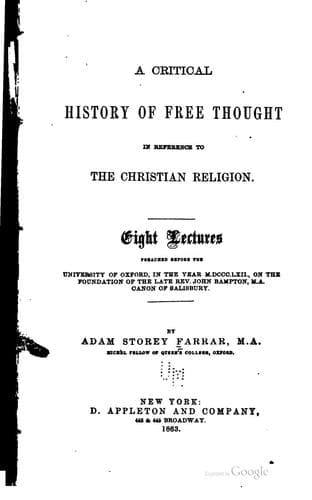
History of Free Thought in Reference to The Christian ReligionFarrar, Adam Storey
History
History of Free Thought in Reference to The Christian Religion
Farrar, Adam Storey
Free thought -- History
The mystical element in this philosophy enabled some minds to find a home
for the theurgy which had been increased by the importation of eastern
ideas.(135) They form as it were the connecting link with the fourth
religious tendency, which manifested itself in the craving for a
communication from the world invisible, which found its satisfaction in
magic and in a spirit of fanaticism. Some of these fanatics were doubtless
also impostors;(136) but some were high-minded men struggling after truth,
of whom possibly an example is seen at an early period in Apollonius of
Tyana; deceived rather than deceivers. This tendency operated in some
minds to cause them to reduce Christianity to ordinary magic and
prodigies; while among a few it created yearnings for a nobler
satisfaction, which drew them toward Christianity, as in the case of the
Clemens, whose autobiography professes to be given in the well-known work
of the early ages, the Clementines. (11)
Such seem to have been the chief forms of religious thought existing among
the heathen to whom Christianity presented itself, on which were founded
the preparation of heart which led to the acceptance of its message, or
the prejudices which rejected its claims;—viz. among the masses, a
sensuous unintelligent belief in polytheism;—among the educated,
disorganization of belief; either materialism, the total rejection of the
supernatural, and a political attachment on the principle of expedience to
existing creeds; or philosophy, ethical, dualistic, pantheistic, despising
religions as mere organic products of national thought, and trying to
seize the central truths of which they were the expression; or a mystical
craving after the supernatural, degrading its victims into fanatics. The
further analysis of these tendencies would show their connexion with the
threefold classification before given of the tests of truth into sense,
reason, and feeling.
We have thus prepared the way for interpreting the lines of argument used
in opposition to Christianity, and shall now proceed to sketch in
chronological succession the history of the chief intellectual attacks
made by unbelievers.
It is not until the middle of the second century that we find Christianity
becoming the subject of literary investigation. Incidental expressions
either of scorn or of misapprehension form the sole allusions in the
heathen writers of earlier date (12); but in the reigns of the Antonines,
the Christians began to attract notice and to meet with criticism. We read
of a work written against Christianity by a Cynic, Crescens, in the reign
of Antoninus Pius;(137) and of another by the tutor of Marcus Aurelius,
Fronto of Cirta,(138) in which probably the imperial persecution was
justified.
Public-domain text, read in full here on John Shaqi.
Reviews
Reviews
No reviews yet
Be the first to share your thoughts on this work.
Elsewhere in the archive
Join the Discussion
Join the discussion
Sign in to leave a comment or review.
Sign InorCreate an account