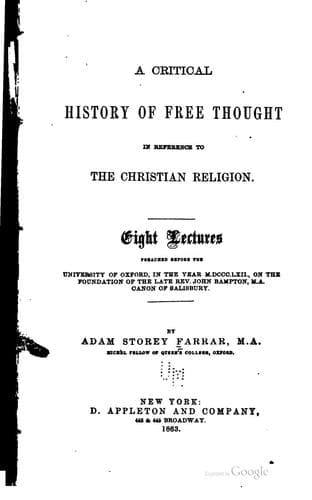
History of Free Thought in Reference to The Christian ReligionFarrar, Adam Storey
History
History of Free Thought in Reference to The Christian Religion
Farrar, Adam Storey
Free thought -- History
His opposition to Christianity was not however based wholly on a prejudice
of feeling. He was a man cultivated in all the learning of his age, and of
a more generous temper than Celsus, and seems to have exercised much
critical sagacity in the investigation of the claims of Christianity.
About the year 270, while in retirement in Sicily, he wrote a book against
the Christians.(200) This work having been destroyed, we are left to
gather its contents and the opinions of its authors from a few criticisms
in Eusebius and Jerome. The entire work consisted of fifteen books; and
concerning only five of these is information afforded by them. Their
remarks lead us to conjecture that it was an assault on Christianity in
many relations. The books however of which we know the purpose, seem to
have been critical rather than philosophical, directed against the grounds
of the religion rather than its character; being in fact an assault on the
Bible. The existence of such a line of argument, of which a trace was
already observable in Celsus, is explained by the circumstance that the
faith of Christendom was already fixed on the authority of the sacred
books. The church had always acknowledged the authority of the Jewish
scriptures; and by the middle or close of the second century at the
latest, it had come to acknowledge explicitly the co-ordinate authority of
a body of Christian literature, historic, and epistolary.(201) Hence, when
once the idea of a rule of faith had grown common, the investigation of
the contents of the scriptures became necessary on the part of heathen
opponents. The growingly critical character of Porphyry’s statements,
though partly attributable to the literary culture of his mind, is a
slight undesigned evidence corroborative of the authoritative nature
already attributed to the scriptures in doctrine and truthfulness.
Porphyry seems accordingly to have directed his critical powers to show
such traces of mistakes and incorrectness as might invalidate the idea of
a supernatural origin for the Jewish and Christian scriptures, and shake
confidence in their truth as an authority.
Public-domain text, read in full here on John Shaqi.
Reviews
Reviews
No reviews yet
Be the first to share your thoughts on this work.
Elsewhere in the archive
Join the Discussion
Join the discussion
Sign in to leave a comment or review.
Sign InorCreate an account