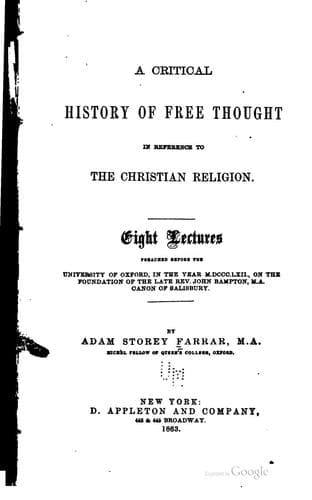
History of Free Thought in Reference to The Christian ReligionFarrar, Adam Storey
History
History of Free Thought in Reference to The Christian Religion
Farrar, Adam Storey
Free thought -- History
If such was the intention of Philostratus, he was really a
controversialist under the form of a writer of romance; employed by those
who at that time were labouring (as already named) to introduce an
eclecticism largely borrowed from the East into the region both of
philosophy and religion. Without settling this question, it is at least
certain that about the beginning of the next century the heathen writers
adopted this line of argument, and sought to exhibit a rival ideal.(219)
One instance is the life of Pythagoras by Iamblichus; another that which
Hierocles wrote, in part of which he used Philostratus’s untrustworthy
memoir for the purpose of instituting a comparison between Apollonius and
Christ. The sceptic who referred religious phenomena to fanaticism would
hence avail himself of the comparison as a satisfactory account of the
origin of Christianity; while others would adopt the same view as
Hierocles, and deprive the Christian miracles of the force of evidence,—a
line of argument which was reproduced by an English deist(220) who
translated the work of Philostratus at the end of the seventeenth century.
The work of Hierocles is lost, but an outline of its argument, with
extracts, remains in a reply which Eusebius wrote to a portion of it (17).
Though couched in a seeming spirit of fairness, the tone was such as would
be expected from one who ungenerously availed himself of the very moment
of a cruel persecution as the occasion of this literary attack.
But the time of the church’s sorrow was nearly past. The hour of
deliverance was at hand. The emperor Constantine proclaimed
toleration,(221) and subsequently established Christianity as the
state-religion. Only one moment more of peril was permitted to befall it.
After an interval in which Christian emperors reigned, Julian ascended the
throne, and employed his short reign of two years(222) in trying to
restore heathenism; and during the last winter of his life, while halting
at Antioch in the course of his Eastern war, wrote an elaborate work
against Christianity.(223) The book itself has been destroyed, but the
reply remains which Cyril of Alexandria thought it necessary to write more
than half a century afterwards; and by this means we can gather Julian’s
opinions, just as from his own letters and the contemporary history we can
gather his plans. The material struggle of deeds belongs in this instance
to our subject, inasmuch as it is the overt expression of the struggle of
ideas.
Public-domain text, read in full here on John Shaqi.
Reviews
Reviews
No reviews yet
Be the first to share your thoughts on this work.
Elsewhere in the archive
Join the Discussion
Join the discussion
Sign in to leave a comment or review.
Sign InorCreate an account