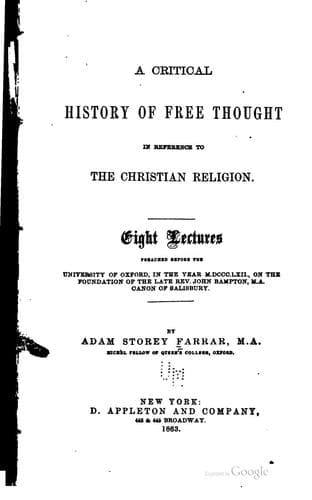
History of Free Thought in Reference to The Christian ReligionFarrar, Adam Storey
History
History of Free Thought in Reference to The Christian Religion
Farrar, Adam Storey
Free thought -- History
The obvious insufficiency however of this analysis to afford an entire
explanation of the prejudices of these early unbelievers points to the
close union before noticed(247)of the emotional with the intellectual
causes. While asserting the possibility of the independent action of the
intellectual element under peculiar circumstances as a cause of doubt, and
while thus vindicating the importance of investigating the history of free
thought from the intellectual side, we admitted the necessity of taking
the probability of the action of the moral element into account when we
pass from the abstract study of tendencies to form a judgment on concrete
instances. Here accordingly, in the mental history of these early
unbelievers, we already encounter cases where philosophy as well as piety
requires that a very large share in the final product be referred to the
influence of emotional causes. Christianity addresses itself to the
compound human nature, to the intellect and heart conjoined. Accordingly
the excitement of certain forms of moral sensibility is as much
presupposed in religion as the sense of colour in beholding a landscape.
The means fail for estimating with historic certainty the particular
emotional causes which operated in the instances now under consideration.
The moral chasm which separates us from heathens is so great that we can
hardly realize their feelings.
If however we cannot pronounce on the positive presence of moral causes
which produced their disbelief, we may conjecture negatively the nature of
those, the absence of which precluded the possibility of faith.
Christianity demands a belief in the supernatural, and a serious spirit in
the investigation of religion, both of which were wholly lacking in
Lucian. It requires a deep consciousness of guilt and of the personality
of God, which were wanting in Celsus. It exacts a more delicate moral
taste to appreciate the divine ideal of Christ’s character than Hierocles
manifested. Porphyry and Julian are more difficult cases for moral
analysis. Porphyry is so earnest a character, so spiritual in his
tastes,(248) that we wonder why he was not a Christian; and except by the
reference of his conduct to general causes, such as philosophical pride,
we cannot understand his motives without a more intimate knowledge than is
now obtainable of his personal history. The difficulty of understanding
Julian’s character arises from its very complexity. Who can divine the
many motives which must have combined with intellectual causes at
successive moments of his life, to change the Christian student, into the
apostate, to convert disbelief into hatred, and to degrade the philosopher
into the persecutor? History happily offers so few parallels to enable us
to form a conjecture on the answer, that we may be content to leave the
problem unsolved.
Public-domain text, read in full here on John Shaqi.
Reviews
Reviews
No reviews yet
Be the first to share your thoughts on this work.
Elsewhere in the archive
Join the Discussion
Join the discussion
Sign in to leave a comment or review.
Sign InorCreate an account