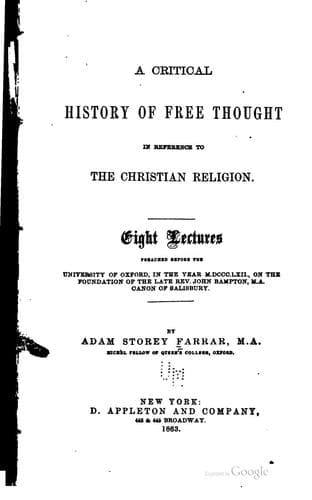
History of Free Thought in Reference to The Christian ReligionFarrar, Adam Storey
History
History of Free Thought in Reference to The Christian Religion
Farrar, Adam Storey
Free thought -- History
The very possibility of the existence of such a comparison presupposes
intercourse with disciples of foreign creeds. The Christians now no longer
possessed a merely vague knowledge of Jews and Mahometans. The crusades
were expiring, the danger which evoked them had subsided, and the enmity
which supported them was decaying. Europe had entered into relations of
commerce, if not of amity, with Mahometan nations; and through contact
with them had come to measure them by an altered standard, and to acquire
the idea of comparing religions. Frederick II, to whom this expression is
imputed, is stated to have manifested admiration of Mahometan literature,
and affection for his Mahometan subjects who afforded him aid in carrying
out the plans of civilization which his powerful mind had formed;(291) and
it was his indifference to a crusade, induced probably by other causes,
which led the Pope to impute to him the blasphemy just quoted. The contact
with the East, half a century later, in like manner afforded the pretext
for fastening a charge of unbelief on the Knights Templars.(292) Contact
with Mahometans had thus, we have reason to believe, created a latitude of
thought in many parts of Christendom.
The same idea of the comparison of Christianity with other creeds
reappears in a tale of Boccaccio,(293) in which the three great religions
are represented under the allegory of three rings which a father gave to
his children, so exactly alike that the judges could not decide which was
the genuine one of the three, and which the copies. It is also illustrated
by the tradition of the existence of a book, entitled “De Tribus
Impostoribus,” which has been attributed almost to every great name in the
middle ages which was conspicuous for opposition to the claims of the
church, or for uneasiness under the pressure of its dogmatic teaching. The
existence of the book is legendary: no one ever saw it: and the two
distinct works which now bear the title can be shown to have been composed
respectively in the sixteenth and seventeenth centuries: but the legend is
a witness to the fact of the existence of the idea which the book was said
to embody. (20)
Public-domain text, read in full here on John Shaqi.
Reviews
Reviews
No reviews yet
Be the first to share your thoughts on this work.
Elsewhere in the archive
Join the Discussion
Join the discussion
Sign in to leave a comment or review.
Sign InorCreate an account