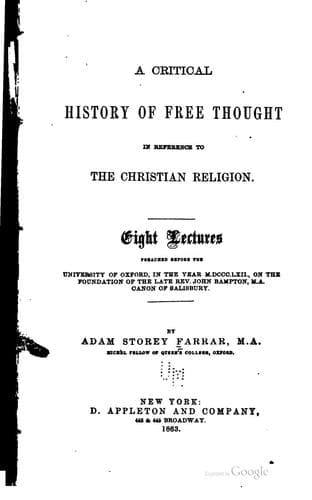
History of Free Thought in Reference to The Christian ReligionFarrar, Adam Storey
History
History of Free Thought in Reference to The Christian Religion
Farrar, Adam Storey
Free thought -- History
The unbelief which existed in the courts for which this poetry was
written, is a specimen of the general incredulity, or indifference to
Christianity, which prevailed among the educated classes, and was fostered
by classical studies and tastes. It seems strange to us, who have been
long accustomed to regard classical culture as the basis of general
education, and who are impressed with the conviction of the great
assistance ministered by it to theological study, to regard it as the
producing cause of unbelief. This result of it however was a transitory
one, originating in the shock which arose from the novel thoughts and
tastes which mingled themselves with the ancient pursuits, and altered the
previous ideal of life. Ever since the earliest times, a chasm had
unavoidably separated heathen literature from Christian; and a dislike to
heathen studies existed, which found its full expression in Gregory the
Great.(309) The result was, that the Christian civilization did not
consciously admit the introduction of heathen thought; and when the mind
awoke suddenly to a perception of its beauty and depth, though deeper
spirits, like Erasmus, regarded it with the enlightened Christian
approbation which Origen had formerly shown, others were led, like Julian
of old, from their admiration of it, to look with indifference or
hostility on Christianity. Some of the brilliant and elevated minds that
adorned the court of the Medicis were suspected of unbelief, or of
preferring Platonism to Christianity;(310) and after the woes of the
French invasion at the end of the century had deepened the corruption of
morals, and stamped out political liberty, the last freshness of artistic
creation, which had linked the public mind to Christianity through the
deep instincts of the taste, disappeared. The art and literature which
succeeded are an index of the tone which prevailed. Gaining perfection in
form by the imitation of classic models, they were cold, sensuous,
unspiritual.(311) Classical mythology was intermixed with gospel
doctrines; and the early years of the sixteenth century represent the
semi-heathen tone of thought which was the transition to the perfect
fusion which afterwards took place of the old learning and the new. It was
an age similar to those of modern times in France and Germany, which have
been called periods of humanism, when hope suggests the inauguration of a
new moral and social era, and the pride of knowledge produces a general
belief in the power of civilization to become the sole remedy for
evil.(312)
Public-domain text, read in full here on John Shaqi.
Reviews
Reviews
No reviews yet
Be the first to share your thoughts on this work.
Elsewhere in the archive
Join the Discussion
Join the discussion
Sign in to leave a comment or review.
Sign InorCreate an account