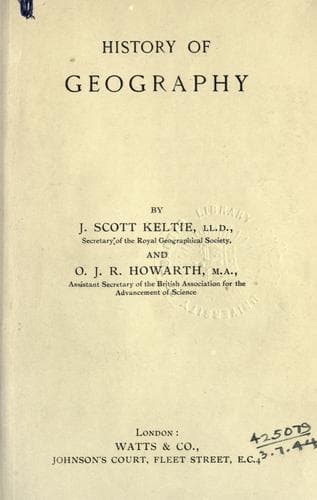
Geomorphology, though not accepted without demur as a definite branch
of science in itself, has at last come to be generally recognized as
a convenient term to connote the study of terrestrial relief. Elie
de Beaumont in 1852 enunciated with too great precision the theory
that similarity of orientation was a standard test of similarity
in the age and origin of the great mountain chains. Lowthian Green
in 1875 proposed his tetrahedral theory of the disposition of the
continents and the ocean basins, on the ground that a sphere undergoing
contraction tends to assume the form of a tetrahedron, or body enclosed
by four equal equilateral triangles. He applied this theory to the form
of the spherical earth at its present stage of contraction, indicated
how far it accounted for the present distribution of land and sea, and
attempted to give reasons for its failure to do so in certain respects.
Professor C. Lapworth in 1892 stated his theory of folding, according
to which the continents are the arches of vast folds in the crust of
the earth, and the ocean basins the troughs between them. E. Suess
has modified this view in his treatise _Das Antlitz der Erde_ (The
Face of the Earth), 1885–1901. Sir George Darwin invoked the effects
of tidal strain upon the crust, associating this with the form of the
continents. The subject, which has also been dealt with by Professors
J. W. Gregory and A. E. H. Love, M. Bertrand, A. de Lapparent, and A.
Supan, among others, has thus been approached from both the purely
physical and the mathematical standpoint, but the problem has not
reached its solution.
We have already given sufficient indication that the exact scope of
geography has not been found easy to define by common consent; that
fact does not lighten the task of tracing its development in the
nineteenth century. It is not inconceivable that on one view of the
subject this volume should have concluded with the preceding paragraph.
On the other hand, the new value attaching to the geographical
studies of distribution and environment makes it imperative to carry
the story further. These studies have not only been systematized in
themselves, but have become complementary of other sciences, and
thus we find the term “geography” incorporated in certain scientific
compounds--zoogeography or zoological distribution; anthropogeography,
the distribution of mankind; biogeography, the distribution of living
things generally--or perhaps more mercifully treated in such phrases
as “plant geography.” Zoogeography and plant geography are concerned
with the division of the earth’s surface into regions possessing
individual characteristics in regard to their fauna or flora. The
principle of regional division, indeed, has become a leading principle
of geographical research, in regard not only to fauna and flora, but to
man as well; to the physical characters of the land, and to climatic
conditions.
Public-domain text, read in full here on John Shaqi.
Reviews
Reviews
No reviews yet
Be the first to share your thoughts on this work.
Elsewhere in the archive
Join the Discussion
Join the discussion
Sign in to leave a comment or review.
Sign InorCreate an account