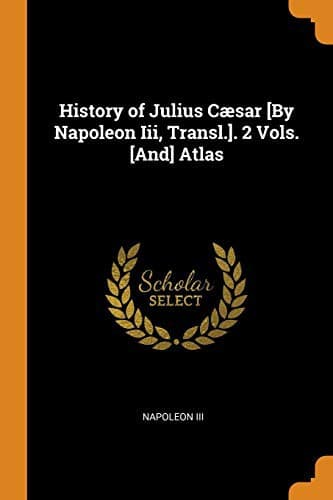
History of Julius Cæsar, Vol. 2 of 2Napoleon III, Emperor of the French
History
History of Julius Cæsar, Vol. 2 of 2
Napoleon III, Emperor of the French
Caesar, Julius; Rome -- History -- Republic, 265-30 B.C.
From that moment Cæsar considered Gaul to be completely pacified; he
resolved, however, to go himself to Aquitaine, which he had not yet
visited, and which Publius Crassus had partly conquered. Arriving there
at the head of two legions, he obtained the complete submission of that
country without difficulty: all the tribes sent him hostages. He
proceeded next to Narbonne with a detachment of cavalry, and charged
his lieutenants to put the army into winter quarters. Four legions,
under the orders of Mark Antony, Caius Trebonius, Publius Vatinius, and
Q. Tullius, were quartered in Belgium; two among the Ædui, and two among
the Turones, on the frontier of the Carnutes, to hold in check all the
countries bordering on the ocean. These two last legions took up their
winter quarters on the territory of the Lemovices, not far from the
Arverni, so that no part of Gaul should be without troops. Cæsar
remained but a short time in the province, presiding hastily over the
assemblies, determining cases of public contestation, and rewarding
those who had served him well. He had had occasion, more than any one,
to know their sentiments individually, because, during the general
revolt of Gaul, the fidelity and succour of the province had aided him
in triumphing over it. When these affairs were settled, he returned to
his legions in Belgium, and took up his winter quarters at Nemetocenna
(_Arras_).
There he was informed of the last attempts of Commius, who, continuing a
partisan war at the head of a small number of cavalry, intercepted the
Roman convoys. Mark Antony had charged C. Volusenus Quadratus, prefect
of the cavalry, to pursue him; he had accepted the task eagerly, in the
hope of succeeding this time better than the first; but Commius, taking
advantage of the rash ardour with which his enemy had rushed upon him,
had wounded him seriously, and escaped; he was discouraged, however, and
had promised Mark Antony to retire to any spot which should be
appointed him, on condition that he should never be compelled to appear
before a Roman.[556] This condition having been accepted, he had given
hostages.[557]
Gaul was henceforth subjugated; death or slavery had carried off its
principal citizens. Of all the chiefs who had fought for its
independence, only two survived, Commius and Ambiorix. Banished far from
their country, they died unknown.
BOOK IV.
RECAPITULATION OF THE WAR IN GAUL, AND RELATION OF EVENTS AT ROME FROM
696 TO 705.
CHAPTER I.
EVENTS OF THE YEAR 696.
[Sidenote: Difficulties of Cæsar’s Task.]
Public-domain text, read in full here on John Shaqi.
Reviews
Reviews
No reviews yet
Be the first to share your thoughts on this work.
Elsewhere in the archive
Join the Discussion
Join the discussion
Sign in to leave a comment or review.
Sign InorCreate an account