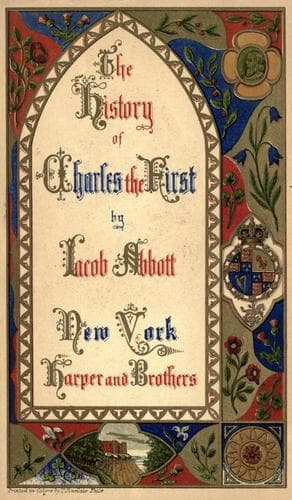
History of King Charles the First of EnglandAbbott, Jacob
History
History of King Charles the First of England
Abbott, Jacob
Charles I, King of England, 1600-1649; Great Britain -- History -- Charles I, 1625-1649; Great Britain -- Kings and rulers -- Biography
When he was introduced to the king's apartment in the morning, the
king said that he wished to have the Scotch commissioners present at
the interview. Joyce replied that the commissioners had nothing to do
now but to return to the Parliament at London. The king then said that
he wished to see his instructions. The cornet replied that he would
show them to him, and he sent out to order his horsemen to parade in
the inner court of the palace, where the king could see them from his
windows; and then, pointing them out to the king, he said, "These, sir,
are my instructions." The king, who, in all the trials and troubles of
his life of excitement and danger, took every thing quietly and calmly,
looked at the men attentively.
They were fine troops, well mounted and armed. He then turned to the
cornet, and said, with a smile, that "his instructions were in fair
characters, and could be read without spelling." The cornet then
said that his orders were to take the king away with him. The king
declined going, unless the commissioners went too. The cornet made no
objection, saying that the commissioners might do as they pleased about
accompanying him, but that he himself must go.
[Sidenote: The king taken to Cambridge.]
[Sidenote: Closely guarded.]
The party set off from Holmby and traveled two days, stopping at night
at the houses of friends to their cause. They reached Cambridge, where
the leading officers of the army received the king, rendering him every
possible mark of deference and respect. From Cambridge he was conducted
by the leaders of the army from town to town, remaining sometimes
several days at a place. He was attended by a strong guard, and was
treated every where with the utmost consideration and honor. He was
allowed some little liberty, in riding out and in amusements, but every
precaution was taken to prevent the possibility of an escape.
[Sidenote: The king's evil.]
The people collected every where into the places through which he
had to pass, and his presence-chamber was constantly thronged. This
was not altogether on account of their respect and veneration for
him as king, but it arose partly from a very singular cause. There
is a certain disease called the scrofula, which in former times had
the name of the King's Evil. It is a very unmanageable and obstinate
disorder, resisting all ordinary modes of treatment; but in the days
of King Charles, it was universally believed by the common people
of England, that if a _king_ touched a patient afflicted with this
disease, he would recover. This was the reason why it was called the
king's evil. It was the evil that kings only could cure. Now, as kings
seldom traveled much about their dominions, whenever one did make such
a journey, the people embraced the opportunity to bring all the cases
which could possibly be considered as scrofula to the line of his
route, in order that he might touch the persons afflicted and heal them.
[Sidenote: The king removed to Hampton Court.]
Public-domain text, read in full here on John Shaqi.
Reviews
Reviews
No reviews yet
Be the first to share your thoughts on this work.
Elsewhere in the archive
Join the Discussion
Join the discussion
Sign in to leave a comment or review.
Sign InorCreate an account