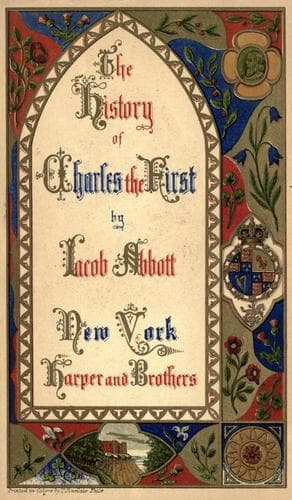
History of King Charles the First of EnglandAbbott, Jacob
History
History of King Charles the First of England
Abbott, Jacob
Charles I, King of England, 1600-1649; Great Britain -- History -- Charles I, 1625-1649; Great Britain -- Kings and rulers -- Biography
The attempts to raise money in these ways made great trouble. The
people resisted, and interposed all possible difficulties. However,
some funds were raised, and a fleet of a hundred sail, and an army of
seven thousand men, were got together. Buckingham undertook the command
of this expedition himself, as there had been so much dissatisfaction
with his appointment of a commander to the other. It resulted just as
was to be expected in the case of seven thousand men, and a hundred
ships, afloat on the swelling surges of the English Channel, under
the command of vanity, recklessness, and folly. The duke came back to
England in three months, bringing home one third of his force. The rest
had been lost, without accomplishing any thing. The measure of public
indignation against Buckingham was now full.
[Sidenote: Another projected.]
[Sidenote: 1628.]
[Sidenote: Assassination of Buckingham.]
Buckingham himself walked as loftily and proudly as ever. He got
up another fleet, and was preparing to set sail in it himself, as
commander again. He went to Portsmouth, accordingly, for this purpose,
Portsmouth being the great naval station then, as now, on the southern
coast of England. Here a man named Felton, who had been an officer
under the duke in the former expedition, and who had been extremely
exasperated against him on account of some of his management there,
and who had since found how universal was the detestation of him in
England, resolved to rid the country of such a curse at once. He
accordingly took his station in the passage-way of the house where
Buckingham was, armed with a knife. Buckingham came out, talking with
some Frenchmen in an angry manner, having had some dispute with them,
and Felton thrust the knife into his side as he passed, and, leaving
it in the wound, walked away, no one having noticed who did the deed.
Buckingham pulled out the knife, fell down, and died. The bystanders
were going to seize one of the Frenchmen, when Felton advanced and
said, "I am the man who did the deed; let no man suffer that is
innocent." He was taken. They found a paper in his hat, saying that he
was going to destroy the duke, and that he could not sacrifice his life
in a nobler cause than by delivering his country from so great an enemy.
[Sidenote: The king not sorry.]
King Charles was four miles off at this time. They carried him the
news. He did not appear at all concerned or troubled, but only
directed that the murderer--he ought to have said, perhaps, the
_executioner_--should be secured, and that the fleet should proceed to
sail. He also ordered the treasurer to make arrangements for a splendid
funeral.
[Sidenote: Buckingham's monument the universal execration of his
countrymen.]
Public-domain text, read in full here on John Shaqi.
Reviews
Reviews
No reviews yet
Be the first to share your thoughts on this work.
Join the Discussion
Join the discussion
Sign in to leave a comment or review.
Sign InorCreate an account