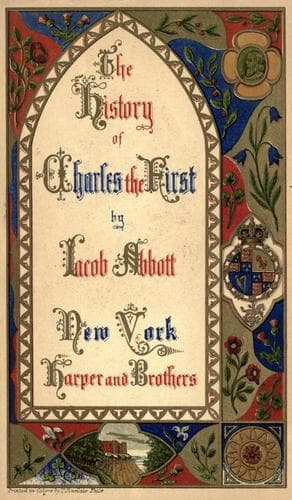
History of King Charles the First of EnglandAbbott, Jacob
History
History of King Charles the First of England
Abbott, Jacob
Charles I, King of England, 1600-1649; Great Britain -- History -- Charles I, 1625-1649; Great Britain -- Kings and rulers -- Biography
The treasurer said, in reply, that a funeral would only be a temporary
show, and that he could hereafter erect a _monument_ at half the
cost, which would be a much more lasting memorial. Charles acceded.
Afterward, when Charles spoke to him about the monument, the treasurer
replied, What would the world say if your majesty were to build a
monument to the duke before you erect one for your father? So the plan
was abandoned, and Buckingham had no other monument than the universal
detestation of his countrymen.
CHAPTER V.
THE KING AND HIS PREROGATIVE.
[Sidenote: Difficulty in raising funds.]
The great difficulty in governing without a Parliament was how to
raise funds. By the old customs and laws of the realm, a tax upon the
people could only be levied by the action of the House of Commons; and
the great object of the king and council during Buckingham's life, in
summoning Parliaments from time to time, was to get their aid in this
point. But as Charles found that one Parliament after another withheld
the grants, and spent their time in complaining of his government, he
would dissolve them, successively, after exhausting all possible means
of bringing them to a compliance with his will. He would then be thrown
upon his own resources.
[Sidenote: The king's resources.]
[Sidenote: Modes of raising money.]
The king had _some_ resources of his own. These were certain estates,
and lands, and other property, in various parts of the country, which
belonged to the crown, the income of which the king could appropriate.
But the amount which could be derived from this source was very small.
Then there were certain other modes of raising money, which had been
resorted to by former monarchs, in emergencies, at distant intervals,
but still in instances so numerous that the king considered precedents
enough had been established to make the power to resort to these modes
a part of the prerogative of the crown. The people, however, considered
these acts of former monarchs as irregularities or usurpations. They
denied the king's right to resort to these methods, and they threw
so many difficulties in the way of the execution of his plans, that
finally he would call another Parliament, and make new efforts to
lead them to conform to his will. The more the experiment was tried,
however, the worse it succeeded; and at last the king determined to
give up the idea of Parliaments altogether, and to compel the people to
submit to his plans of raising money without them.
[Sidenote: Parliaments abandoned.]
[Sidenote: The government attaches the property of a member of
Parliament.]
Public-domain text, read in full here on John Shaqi.
Reviews
Reviews
No reviews yet
Be the first to share your thoughts on this work.
Join the Discussion
Join the discussion
Sign in to leave a comment or review.
Sign InorCreate an account